 Angkor Wat Tours
Angkor Wat Sunrise: Times, Spots and Tours
The Angkor Wat sunrise is the best-known hour of a temple visit in Siem Reap. The sun comes up behind the towers, the towers reflect in the ponds in front of the temple, and the park lets you in from 5:00 AM to catch it. This guide gives the sunrise times by month, the spot where the reflection lines up, the equinox alignment, the sunset alternatives and the prices of the sunrise tours from Siem Reap. Every tour price on this page leaves out the Angkor Pass, so the total you pay is always higher than the listing. Compare all Angkor Wat tours before you book.
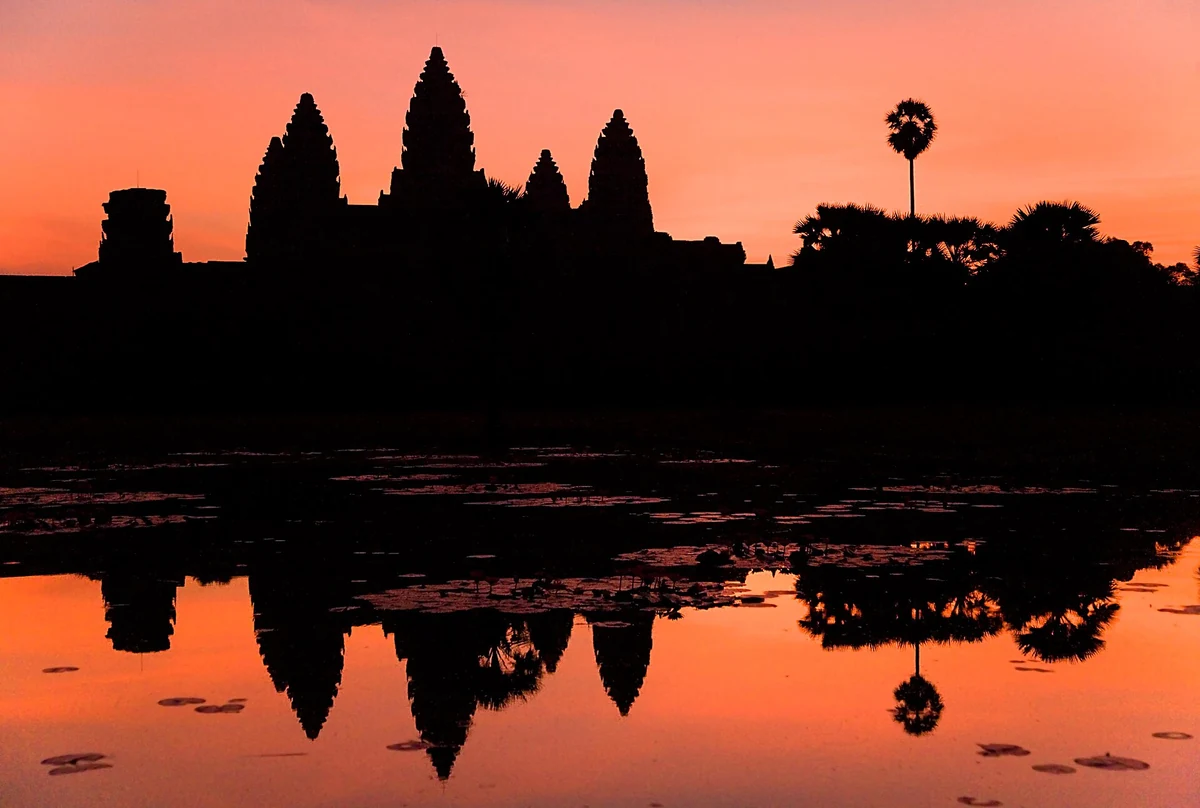
Angkor Wat silhouetted against an orange dawn sky and reflected in the pond. Photo: Chi King, CC BY 2.0, via Wikimedia Commons
Quick answer Angkor Wat sunrise in brief
The Angkor Wat park opens at 5:00 AM and the sun rises in Siem Reap between 5:37 am in June and 6:31 am in January, so you arrive in the dark and wait for the light. The sun rises behind Angkor Wat, which faces west, and the reflection shows best in the water basins in front of the temple.
Key takeaways
- The pick for a first visit is the Angkor Wat Highlights Sunrise Tour at $19 per person, pickup at 4:15 to 4:35 AM, plus the $37 pass, so you pay $56.
- Want a driver without the crowd schedule? The Private Angkor Sunrise Tour runs 7 hours from $30 per person with pickup at 4:45 AM, pass extra.
- Check the sunrise times by month before booking, because sunrise ranges from 5:37 am to 6:31 am across the year.
- For the evening side, see the sunset spots: Phnom Bakheng, Pre Rup and Srah Srang each have their own rules.
Is the Angkor Wat Sunrise Worth It?
A straight answer for anyone weighing a 4:30 AM alarm against a few more hours of sleep.
The Verdict and the Crowd
Yes, go once. The sky over the towers runs from pitch black through pink and purple to orange, and the towers reflect in the lotus pond in front of the temple. Travellenz describes hundreds of people gathering each morning for it.
Tom Henty's Travel puts the scramble for the classic pond spot at about 500 people, so claim a place early or book one of the Angkor Wat tours, since Tom Henty's Travel says a guide gets you in position first. Cloud can block the sun itself, but Hello Angkor notes that cloud adds drama to the sky in the rainy season, so a grey forecast is not a wasted morning.
Source: Tom Henty's Travel, Travellenz, Hello Angkor.
Sunrise Times by Month
Siem Reap sits close to the equator, so sunrise never moves far from 6:00 am. The table uses the mid-month figures for Siem Reap from sunrise-sunset.org.
What the Times Mean for Your Morning
The park gate opens at 5:00 AM and the temples open at sunrise, according to Wikivoyage and the official Angkor Enterprise ticket page, which lists entry from 5:00 AM to 6:30 PM. In practice you leave your hotel around 4:30 AM for most of the year. In 2026 Siem Reap's earliest sunrise is 5:36 am on 31 May and the latest is 6:31 am on 23 January, a spread of less than an hour across the whole year. Sunset runs from 5:34 pm on 19 November to 6:35 pm on 9 July.
Cambodia's average high in Siem Reap never falls below 30 C in any month, and March to May can reach 40 C, so the dawn hour is also the coolest hour you will get. The rainy season runs May to October. November to February is the dry peak season at 25-30 C, which is when the ponds fill with the biggest crowds.
| Month | Sunrise | Sunset |
|---|---|---|
| January | 6:31 am | 5:56 pm |
| February | 6:27 am | 6:10 pm |
| March | 6:12 am | 6:14 pm |
| April | 5:51 am | 6:17 pm |
| May | 5:38 am | 6:23 pm |
| June | 5:37 am | 6:32 pm |
| July | 5:45 am | 6:35 pm |
| August | 5:51 am | 6:26 pm |
| October | 5:55 am | 5:45 pm |
| November | 6:03 am | 5:34 pm |
| December | 6:19 am | 5:39 pm |
How Other Guides Round the Times
Hello Angkor rounds Siem Reap sunrise to about 6:30 AM from January to April, about 5:30 AM from May to July and about 6:00 AM from August to December. Journey Cambodia gives a single figure of about 5:40 AM. The month table above uses the precise daily figures for 2026, with the earliest sunrise at 5:36 AM on 31 May and the latest at 6:31 AM on 23 January, so treat the rounded guide numbers as approximations and the table as the reference.
Sources: sunrise-sunset.org, Siem Reap, Angkor Enterprise, Wikivoyage.
Where to Stand
Angkor Wat faces west, unlike most Khmer temples, so the sun rises directly behind it from the main entrance. The moat is about 190 m wide with a perimeter over 5 km, and you cross the western causeway toward the entry tower.
The Ponds in Front of the Temple
Wikivoyage's advice is specific: for the Angkor Wat sunrise, stand at the extreme left of the entry tower. There is a reflecting water basin on the left side, and the towers and their reflection in the water are the photograph everyone comes for. In November and December the sun rises to your right as you face the temple, which is why the far left position works for that season.
Expect company at the ponds. A tour with a fixed pickup, such as the Angkor Wat Small-Group Sunrise Tour at $15 per person (8 to 9 hours), takes the transport off your hands. If you go on your own, note that some tuk-tuk drivers charge about US$3 extra for a 5:00 AM start, and a full-day tuk-tuk runs about US$15 to US$20 for the main temples according to Wikivoyage.
The Equinox Alignment
Twice a year the geometry gets better. Wikipedia notes that at the spring and autumn equinoxes the rising sun lines up with the central tower of Angkor Wat when seen from the western entrance causeway. The alignment is strongest around the March and September equinoxes.
On those mornings the causeway itself, further back from the ponds, is the spot where the alignment reads.
A Quieter Water Option: Srah Srang
If the ponds feel too tight, Srah Srang is the alternative. It is a reservoir about 700 by 350 m, dug in the mid-10th century, with a stone landing stage opposite Banteay Kdei. Wikipedia calls its landing stage a popular sunrise spot.
Several tours build it in: the Angkor Wat Highlights Sunrise Tour lists Srah Srang among its stops and serves breakfast there, at your own expense.
The State of the Ponds
Hello Angkor reports that the north pond, the classic photo spot, can turn green with algae, and that it was fenced off for upgrade works at the time of that guide. The same page lists the library steps, the entrance causeway and the outer entry gopura as fallback positions when the pond edge is crowded or closed. Conditions change, so look over both pond banks as you walk in and shift position if the water is low or the near side is fenced.
Sources: Wikivoyage, Wikipedia, Angkor Wat, Wikipedia, Srah Srang.
Other Sunrise Spots in the Park
Angkor Wat is the classic, but not the only place the park opens before the sun.
Four Alternatives
Srah Srang, a reservoir about 700 by 350 m dug in the mid-10th century, is a popular sunrise spot at its landing stage and is covered above. Pre Rup is better known as a sunset hill, but Asia Top Travel lists it among spots open at 5 AM. Phnom Bakheng, about 1.5 km north-west of Angkor Wat, works at dawn too, though the climb takes about half an hour.
Phnom Krom, a mountain temple toward Tonle Sap, appears on Hello Angkor's list. Hours differ by source, so the table sets out what each guide states.
- Phnom Krom toward Tonle Sap appears on Hello Angkor's list of alternatives, with no hours given
| Spot | Hours (siemreap.net) | Notes |
|---|---|---|
| Angkor Wat | 5:00 AM-6:00 PM | The classic pond reflection |
| Srah Srang | 5:00 AM-7:00 PM | Landing stage sunrise spot |
| Pre Rup | 5:00 AM-7:00 PM | Temple-mountain, better known for sunset |
| Phnom Bakheng | 6:00 AM-7:00 PM | Hello Angkor says 5 AM, sources conflict |
Source: siemreap.net, Hello Angkor, Asia Top Travel.
After Sunrise: The Next Three Hours
Most visitors leave with the first colour. Staying pays off.
Stay for the Light, Then Walk the Galleries
Hello Angkor points out that the sunrise light changes last about 90 minutes, so do not head for the exit once the sky turns orange. Travellenz suggests walking the bas-reliefs next, while the stone is still cool and the morning sun lights the outer courtyards. Tom Henty's Travel describes how a full sunrise day continues with the Angkor Wat galleries, then Ta Prohm and the Bayon, with most of the walking done at dawn before the heat builds.
If you would rather hand the sequencing to someone else, the Private Angkor Wat Ta Prohm Angkor Thom Tour picks up around 4:45 AM for sunrise and runs 4 to 5 hours through Angkor Wat, Ta Prohm and Angkor Thom, and the Angkor Wat tours comparison shows who covers what.
Source: Hello Angkor, Travellenz, Tom Henty's Travel.
What to Bring for a Pre-Dawn Start
The park is dark, cool and half asleep when you arrive. Pack for that.
The Packing List
Tom Henty's Travel recommends water and snacks, because nothing is open that early and temple vendors charge high prices, plus sunscreen, insect repellent, spare phone storage and small cash in US dollars or riel. A headlamp or phone light matters more than people expect, since the stones around the entrance trip you in the dark. Asia Top Travel's list adds a light jacket for the cool ride out and a tripod.
For photography, Journey Cambodia suggests a wide-angle lens, filters and spare batteries and memory cards. Whatever you carry, remember the wake-up is around 4:30 AM, so lay everything out the night before. The Angkor Wat Highlights Sunrise Tour starts with pickup between 4:15 AM and 4:35 AM, and breakfast at Srah Srang on that trip is at your own expense.
Source: Tom Henty's Travel, Asia Top Travel, Journey Cambodia.
Sunset Spots
If dawn does not fit your schedule, the park's evenings deliver too. Each spot below has a rule attached, and the figures come from Wikivoyage and Wikipedia.
Choosing Your Evening
Phnom Bakheng is the classic choice and the most crowded. Angkor Wat lies about 1.5 km to the south-east of the hill, and the climb to the top takes about half an hour, so start early. No climbing is allowed after 17:30. Wikipedia's infobox puts the summit at 79 m above sea level, and the same article says the temple sits about 65 m above the surrounding plain, so both figures circulate. Be aware that the sun does not set over Angkor from up there. For the full rules and history of the hill, see Phnom Bakheng.
Pre Rup is the calmer pick. Wikivoyage names it a popular sunset spot over the countryside. It is a brick temple-mountain dedicated in 961 or early 962, with a pyramid about 12 m high and 50 m square at its base. Srah Srang works at both ends of the day: a terrace leads down to the pond opposite Banteay Kdei.
The evening ticket rule ties it together. A pass dated tomorrow allows entry from 4:45 PM today according to siemreap.net, and Wikivoyage reports that a pass bought after 17:00 counts from the next day. The evening entry therefore does not use up a day, so a sunset visit the evening before your pass starts costs no extra pass day. Full prices and pass types sit on the Angkor Wat tickets page.
| Spot | Rule | Note |
|---|---|---|
| Phnom Bakheng | No climbing after 17:30 | Climb takes about half an hour, very crowded, the sun does not set over Angkor from the top |
| Pre Rup | Park closes 6:30 PM | Brick temple-mountain, sunset over the countryside, pyramid about 12 m high |
| Srah Srang | Park closes 6:30 PM | Terrace to a pond about 700 by 350 m opposite Banteay Kdei, also a sunrise spot |
| Angkor Wat | Park closes 6:30 PM | Wikivoyage lists the top tier or the outside of the temple as evening options |
Tours That End at Sunset
Two catalog trips put the sunset in the plan. The Angkor Wat Full-Day Tour with Sunset costs $14 per person for 9 hours, pickup at 9:10 to 9:30 AM, and finishes at Phnom Bakheng. The Angkor Wat 2-Day Tour costs $34 per person over two days and ends day two with the Phnom Bakheng sunset after the big-circuit temples.
Neither includes the Angkor Pass. Wikivoyage reports elephant rides down Phnom Bakheng cost US$15 but advises against them for animal welfare reasons.
Sources: Wikivoyage, Wikipedia, Phnom Bakheng, siemreap.net, Angkor Enterprise.
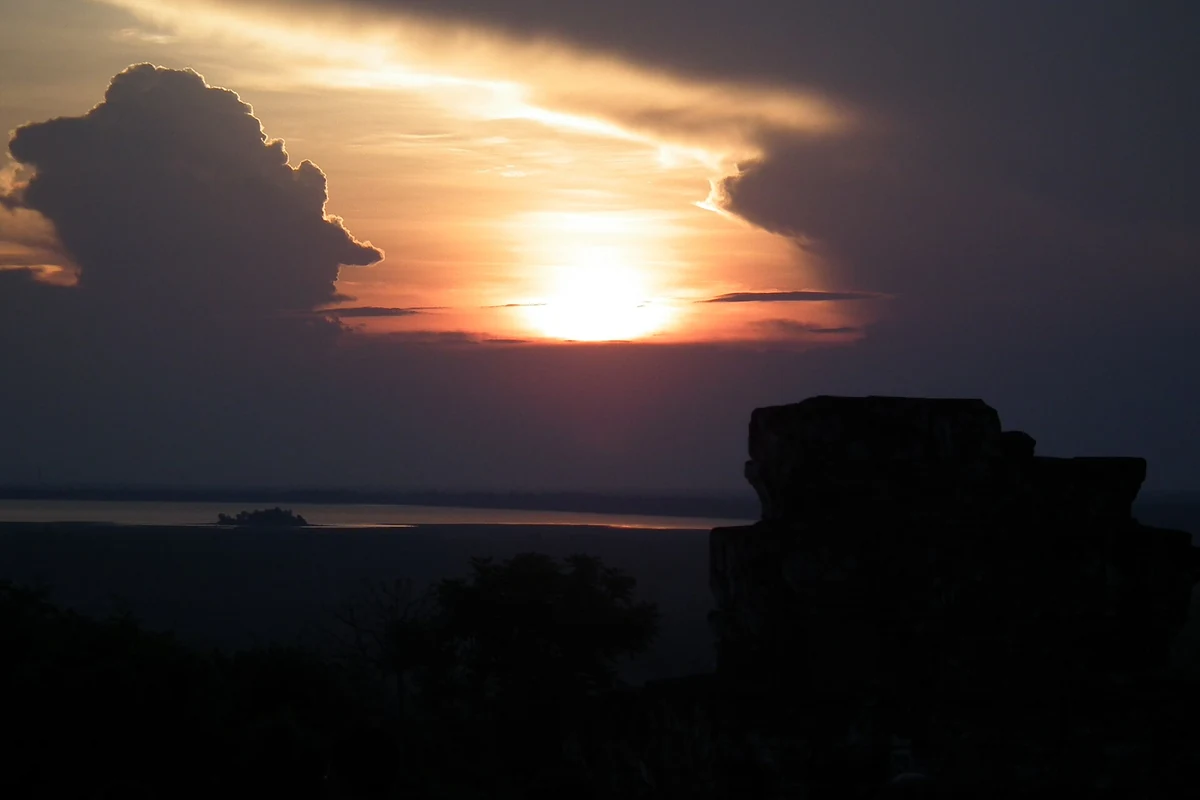
The sun setting over the horizon seen from Phnom Bakheng. Photo: 松岡明芳, CC BY-SA 3.0, via Wikimedia Commons
Sunrise Tours Compared
Every sunrise tour in the catalog sells the day without the Angkor Pass, which runs US$37 per person for one day. The You pay column shows the listed price plus the Angkor Pass.
How the Dawn Trips Differ
The group tours cluster between $15 and $39 per person before the pass. The cheapest, the Angkor Wat Small-Group Sunrise Tour at $15, takes a standard group up to 15 people, and is not suitable for children under 4. The Angkor Wat Highlights Sunrise Tour at $19 caps at 15 people and rules out children under 8, with a return by 1:30 PM. The Vespa or tuk-tuk option at $39 caps at 8 and is the only one with breakfast and lunch in the price. The sunrise cycling tour at $69 includes the bike and helmet for a 15 to 25 km ride after dawn.
The private options start at $30 per person with pickup at 4:45 AM and run to $75 per person for a 4 to 5 hour SUV trip with pickup around 4:45 AM. The $75 trip also offers a normal start from 9:00 AM if you skip the sunrise.
| Tour | Pickup | Price | You pay |
|---|---|---|---|
| Angkor Wat Small-Group Sunrise Tour | None stated | $15 per person | $52 |
| Angkor Wat Highlights Sunrise Tour | 4:15 AM to 4:35 AM | $19 per person | $56 |
| Angkor Sunrise Tour by Vespa or Tuk Tuk | 4:30 AM | $39 per person | $76 |
| Private Angkor Sunrise Tour | 4:45 AM | $30 per person | $92 |
| Angkor Wat Sunrise Private Tour | None stated | $52 per person | $89 |
| Private Angkor Wat Ta Prohm Angkor Thom Tour | Around 4:45 AM | $75 per person | $112 |
| Angkor Sunrise Cycling Tour | 4:30 AM to 4:40 AM | $69 per person | $106 |
Buying the Pass for a Dawn Start
The ticket queue matters more at sunrise than at any other hour. Buying a pass takes 5 to 25 minutes and the rush comes before 5 AM, so the practical move is to buy online the day before, or at the office the day before. The official site angkorenterprise.gov.kh lists the park entry from 5:00 AM and closing at 6:30 PM on all three passes.
On the Small-Group Sunrise Tour the guide helps you buy the pass on the day, but that eats into the dark-hour buffer. Wikivoyage reports the 3-day pass as any 3 days within one week and the 7-day pass as any 7 days within one month.
Tour, Driver or Scooter
A guided tour is one of three ways in. Asia Top Travel sets out the choice as joining a tour, hiring a driver or renting a scooter, and puts scooter rental at $10 to $20 a day. Wikivoyage's figures for a hired tuk-tuk are about US$15 for the main temples and US$20 to $30 for outlying ones, with a sunrise start adding about US$3.
A driver takes you between temples and, as on the Angkor Wat Private Tuk-Tuk Tour listing, does not guide you inside them. A tour adds a guide and a fixed dawn pickup, and some guides help you buy the pass, but the Angkor Pass is an extra on every sunrise listing above.
Sources: Angkor Enterprise, Angkor Photography Tours, Wikivoyage.
Where to Stay for a 4:30 AM Start
Your base decides how painful the alarm is.
Base Yourself in Siem Reap
Tom Henty's Travel notes that boutique hotels in Siem Reap sit about 15 minutes from Angkor Wat by tuk-tuk and will arrange a 4:30 AM tuk-tuk and an early breakfast box if you ask the night before. Travellenz's account is that the hotel woke guests, lent flashlights and packed a take-away breakfast, which turns the early start into a small logistics problem rather than a hardship. Asia Top Travel frames the choice as the city centre, close to restaurants and local life, versus the resort belt just outside, closer to the park gates.
Either way, confirm the pickup time when you book, or let a tour handle it. The Angkor Wat Small-Group Sunrise Tour and most other Angkor Wat tours include hotel pickup.
Source: Tom Henty's Travel, Travellenz, Asia Top Travel.
Sunrise Tips
Do
- Do buy your Angkor Pass online or the day before, because buying it at the office takes 5 to 25 minutes and the queue peaks before 5 AM.
- Do stand at the far left of the entry tower, because that is where the reflecting basin on the left side puts the towers and their reflection in one frame.
- Do aim for November to February if you can, because that is the dry peak season at 25-30 C, while March to May reaches 40 C.
- Do use the evening pre-entry trick, because a pass dated tomorrow lets you in from 4:45 PM today according to siemreap.net, and that sunset does not use up a day.
- Do budget about US$3 extra for a tuk-tuk sunrise start on your own, because Wikivoyage reports drivers add that for the 5:00 AM pickup.
Don't
- Don't book a sunrise tour believing the pass is included, because every tour in the catalog leaves the $37 one-day Angkor Pass out of its price.
- Don't plan to climb Phnom Bakheng after 17:30, because climbing stops then and the walk up takes about half an hour.
- Don't skip the equinox if your dates allow it, because at the spring and autumn equinoxes the rising sun lines up with the central tower from the western causeway.
- Don't count on the elephant ride down Phnom Bakheng, because it costs US$15 and Wikivoyage advises against it for animal welfare reasons.
Angkor Wat Sunrise Questions
What time should I arrive for the Angkor Wat sunrise?
The park opens at 5:00 AM and temples open at sunrise, with the sun rising between 5:37 am in June and 6:31 am in January in Siem Reap. Most tours pick up between 4:15 and 4:45 AM. See the month-by-month table above or the Angkor Wat Highlights Sunrise Tour for a worked example.
Do I need the Angkor Pass for sunrise?
Yes. Entry to the park from 5:00 AM requires a valid pass, and the one-day pass is US$37 per person. No tour price on this site includes it. The pass types, where to buy and the online option are on the Angkor Wat tickets page.
Where is the best spot for the Angkor Wat sunrise photo?
Stand at the extreme left of the entry tower, where the reflecting water basin sits, according to Wikivoyage. In November and December the sun rises to your right as you face the temple. The pond at Srah Srang is the quieter alternative.
How much does an Angkor Wat sunrise tour cost?
Group sunrise tours run from $15 to $39 per person and private options from $30 to $75 per person, always before the pass. The cheapest group option is the Angkor Wat Small-Group Sunrise Tour at $15 per person for 8 to 9 hours, or $52 with the pass.
Is sunset at Angkor Wat as good as sunrise?
It is a different picture, and Pre Rup and Srah Srang are the alternatives to Phnom Bakheng. Phnom Bakheng is the famous one but very crowded, climbing stops at 17:30, and the sun does not set over Angkor from its top. For tours that end on the hill, see the Angkor Wat Full-Day Tour with Sunset.
Can I enter the park the evening before my pass starts?
Yes. Siemreap.net says a pass dated tomorrow allows entry from 4:45 PM today, and Wikivoyage adds that a pass bought after 17:00 counts from the next day. That means a sunset visit the evening before your pass starts costs no extra pass day. Timing details sit on the Angkor Wat tickets page.
Is it worth seeing the sunrise at Angkor Wat?
Yes, once. The sky over the towers runs from black through pink and purple to orange, with the towers reflected in the pond. Tom Henty's Travel puts the crowd at about 500 people at the classic pond spot, so arrive early or book a small-group sunrise tour, since a guide gets you in position first.
What should I bring to the Angkor Wat sunrise?
Water and snacks, since nothing is open that early, a headlamp or phone light for the uneven stones, sunscreen, insect repellent and small cash in US dollars or riel. Photographers add a tripod and a wide-angle lens for the reflection shot. The full rundown is in the packing list above.
Can I wear shorts in Angkor Wat?
Plan on covered shoulders and knees. The Angkor Wat Full-Day Tour with Sunset listing says shorts, short skirts and sleeveless shirts are not allowed, so wear light long trousers or a knee-length skirt. More on the temple itself sits in the Angkor Wat guide.
Is 1 day enough for Angkor Wat?
One day covers Angkor Wat, the Bayon and Ta Prohm if you start at sunrise, which is the plan of the 8 to 9 hour group tours such as the Angkor Wat Small-Group Sunrise Tour. Two days let you add the Grand Circuit temples without rushing, and the Angkor Wat 2-Day Tour shows how that splits across a sunrise day and a sunset day.