 Angkor Wat Tours
Tonle Sap and the Floating Villages
Tonle Sap is the huge lake south of Siem Reap that swells and shrinks with the seasons, and the floating villages along its edge are a side trip many visitors pair with the temples. This guide compares the villages, explains the reversing river, sets out the boat tickets as the official Angkor Enterprise site gives them, and flags the scams that Wikivoyage warns about. It also breaks down what the one catalog trip that includes the lake, the Angkor Wat and Floating Village 2-Day Tour, actually leaves out of its price. For the temples themselves, see the full comparison of Angkor Wat tours and the Siem Reap guide.
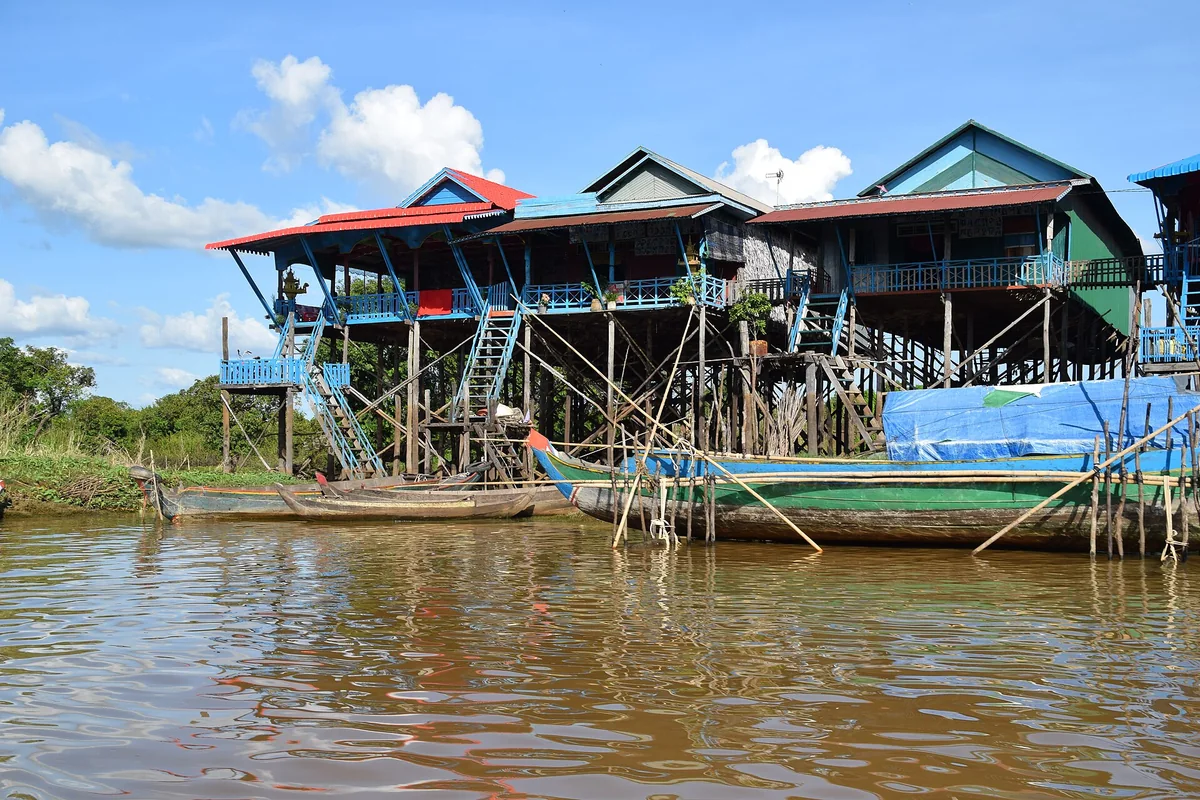
Stilt houses and boats on the water at Kampong Phluk. Photo: Krzysztof Golik, CC BY-SA 4.0, via Wikimedia Commons
Quick answer Tonle Sap in brief
Tonle Sap spreads to about 16,000 sq km in the wet season, shrinking to about 2,500-3,000 sq km in the dry season. The nearest floating village, Chong Kneas, is about 15 km south of Siem Reap, and Kampong Phluk about 20 km south-east. Official Chong Kneas boat tickets are sold at the counter, not online. One catalog trip pairs the lake with the temples.
Key takeaways
- The Angkor Wat and Floating Village 2-Day Tour covers Kampong Phluk and the lake on day two for $235 per group, with the boat ride and entrance fees excluded.
- Compare the villages by distance, water level and boat access in the village comparison table.
- Time your visit by water level with the best months guide.
- Sort the temples first: the Angkor Pass and tour costs page explains what every tour leaves out.
The Lake That Changes Size
Tonle Sap behaves like no other large lake. Its area, volume and depth swing enormously between the dry and wet season, and the river that feeds it changes direction twice a year.
Two Lakes in One Year
In the dry season Tonle Sap covers roughly 2,500-3,000 sq km and holds about 1 cubic km of water at a depth of around 1 m. In the wet season the same lake spreads to about 16,000 sq km and holds about 80 cubic km at 9-14 m deep. The monsoon pushes the Mekong back up the Tonle Sap River, the lake floods the surrounding forest and farmland, and then everything drains away again over the following months.
For a visitor the practical effect is simple. Villages that float on the water in the wet season stand on mud or on tall stilts in the dry season. Check which village you are being sold before you commit, because the experience changes completely with the water level.
The River That Reverses
The Tonle Sap River runs 115-120 km between the lake and the Mekong. For about six months it flows one way, carrying lake water down to the Mekong, and for the other six months the flooded Mekong pushes water back up into the lake. The switch happens roughly every six months, around the monsoon cycle.
This reversal is why the lake swells so far and so fast.
A Protected Biosphere
UNESCO nominated Tonle Sap as a Biosphere Reserve in 1997, and Cambodia confirmed it by royal decree in 2001. The core areas, where nature protection is strictest, cover 42,300 hectares. They are Prek Toal in Battambang province, and two zones in Kampong Thom province, Boeng Tonle Chhmar, which is also a Ramsar wetland site, and Stung Sen.
If your interest is birds rather than villages, the dry season months are the time to go, as the receding water concentrates the birds into a smaller area.
The Lake Under Pressure
The lake has had hard years. The International Business Times reports the reverse flow reached its lowest level since 1997 in one recent season, and Wikipedia records a record-low water level for July in 2020, the lowest in 60 years. The International Business Times blames upstream dams and drought.
For you as a visitor this means the dry-season lake can look smaller and browner than the photos, so set expectations before you book a boat. Pairing the lake with temple days still works, and the Angkor Wat tours show what else a Siem Reap day can hold.
Sources: Wikipedia: Tonle Sap, Wikipedia: Tonle Sap Biosphere Reserve.
Fish, Birds and Wildlife
The lake is the engine of Cambodian fishing, and its flooded forest is where the fish breed.
The Inland Fishery
Otherwise Cambodia describes the flooded forest as the breeding shelter for fish and says the lake supplies more than half of the fish eaten in Cambodia. Wikipedia puts it at about 60% of the annual freshwater catch of over 400,000 tons. Wikipedia records at least 149 fish species, 11 of them globally endangered, plus the nearly extinct Siamese crocodile.
Otherwise Cambodia quotes 300 or more species, which conflicts with Wikipedia's 149.
Prek Toal Bird Reserve
Aqua Expeditions describes the 22,000-hectare Prek Toal Core Bird Reserve as a refuge for the spot-billed pelican, milky stork, black-headed ibis and masked finfoot. It is one of the three core zones of the UNESCO biosphere, along with Boeng Tonle Chhmar and Stung Sen. A bird trip here is a separate outing from the village boat loops, for travelers with a particular interest in waterbirds.
Wikivoyage names November to April, the dry season, as the best time for birds, as the water recedes into a smaller area. That is the same window the when to go section covers.
Source: Wikipedia.
Life on the Water
Tonle Sap is not just water and birds. Roughly 1.2 million people live in the lake area, and many of them live on it.
Floating Houses and Stilt Houses
Aqua Expeditions separates two kinds of village on the lake. Floating villages are built on movable houses that can be shifted as the water rises and falls. Stilted villages are permanent, with tall stilts and very long ladders for the dry months when the water drops away.
Kampong Phluk is the stilted kind, and its houses stand on stilts of roughly 6 to 9 m. What you see depends on the season: Exotravel says the stilt houses look as if they float in the lake season, and in the dry months they tower over dry ground.
Who Lives Here
Most of the lake's fishermen are ethnic Vietnamese, and Cham communities also live in floating villages around it, alongside Khmer families. These are working communities, not shows for visitors. The International Business Times lists schools, hairdressers, coffee shops and even dentists in the floating villages, all reached by canoe and small motorboat.
Kampong Phluk commune alone counted 3,707 people in 2019. Wikipedia says its residents fish mainly for shrimp in the wet season and turn to farming in the dry season. When you visit, it is fair to ask the boat operator what share of the ticket money stays in the village.
Source: Wikipedia.
The Floating Villages Compared
Five places around the lake come up for Siem Reap visitors, and they are not interchangeable. Distance, water level and honesty of pricing all differ, so the table below lines up what Wikivoyage and the official sources say about each before you choose.
Which Village to Pick
Chong Kneas is the closest at about 15 km south of Siem Reap by paved road, which makes it the default choice for short itineraries. Wikivoyage, however, warns that it is in a bad state for visitors and that scam practices there are well established. Kampong Phluk, about 20 km south-east, is a stilted village rather than a floating one: its houses stand 6-9 m above the ground, and its 3,707 residents, counted across 911 families, fish for shrimp in the wet season and farm in the dry. Wikivoyage warns that Chong Kneas-style scams are beginning to show there too.
Kampong Khleang and Mechrey are other villages some trips go to. No distance or fee is published for either, so check any figure quoted to you. Prek Toal is a biosphere core zone in Battambang province, not a quick village visit. Boats and drivers at all the access points are rented per person or per boat, so the price you pay depends on how many of you there are.
Village Comparison
Distances come from Wikivoyage, Kampong Phluk figures from Wikipedia, and ticketing rules from the official Angkor Enterprise site.
| Village | Distance | What you see | Boat |
|---|---|---|---|
| Chong Kneas | About 15 km south of Siem Reap | Floating village, closest to town | Official boat packages, bought at the counter, not online |
| Kampong Phluk | About 20 km south-east | Stilt houses 6-9 m high, fishing village in the wet season | Wikivoyage lists a boat tour at US$25 per person |
| Kampong Khleang | not stated | Not stated | not stated |
| Mechrey | not stated | Not stated | not stated |
| Prek Toal | not stated | Biosphere core zone in Battambang province | Dry season is best for birds (Wikivoyage) |
How the Official Tickets Work
The official Angkor Enterprise site lists Chong Kneas as a separate area alongside Koh Ker, Beng Mealea and Kbal Spean, and it is the body that sells temple passes and area tickets. For Chong Kneas it states clearly that boat-ride tickets are not sold online and must be bought at the counter. The packages come in small, medium and large boats, with separate rates for Cambodian and international visitors, payable in US dollars or riel.
The small boat is described as suited to couples, solo travelers and small families, and the medium boat has sunshade roofs and a centre corridor. No per-boat figure is published, so ask at the counter and expect a range of package options rather than a single fare.
What the Boat Loop Is Actually Like
At Chong Kneas, about 15 km south of Siem Reap, Otherwise Cambodia describes a boat loop of about 2 hours with two stops, one of them a floating gift shop, and says the area is run by a private firm that has raised prices. The official Angkor Enterprise site sells Chong Kneas boat tickets at the counter only, not online. Wikivoyage lists a Kampong Phluk floating village boat tour at US$25 per person as a market rate, and notes that at the access points boats are rented per person or per boat.
Whatever the village, agree the price and the stops before you board.
Sources: Wikivoyage: Tonle Sap, Angkor Enterprise: Chong Kneas, Wikipedia: Kampong Phluk.
When to Go
There is no single best month for Tonle Sap. The right time depends on if you want deep water, tall stilt houses and lush flooded forest, or receding water, concentrated birdlife and easier dry landings.
Water Level by Season
The lake sits at roughly 1 m deep at the end of the dry season and rises to 9-14 m at the peak of the rains. The wet season runs about May to October, when Kampong Phluk residents fish mainly for shrimp, and the dry season runs about November to April, when they turn to farming. In the wet months the villages genuinely float, and the lake reaches its full 16,000 sq km. In the dry months the water retreats, and the stilt houses of Kampong Phluk stand tall over dry ground.
For birds, Wikivoyage names November to April, the dry season, as the best time, because the receding water concentrates birdlife into a smaller area. That makes the dry season the window for a Prek Toal trip. For the classic floating-village photo with houses surrounded by water, the late wet season and the months just after the rains are stronger.
Pairing the Lake with Your Temple Days
The nearest villages sit about 15 to 20 km from Siem Reap, so the lake fits around a temple day or on a separate day. The seasons, heat and sunrise hour page on the homepage sets out how the temple calendar fits the same weather patterns. If you are deciding between one, two or three days at the temples before adding the lake, the how many days section breaks the trade-offs down.
Sources: Wikivoyage: Tonle Sap, Wikipedia: Kampong Phluk.
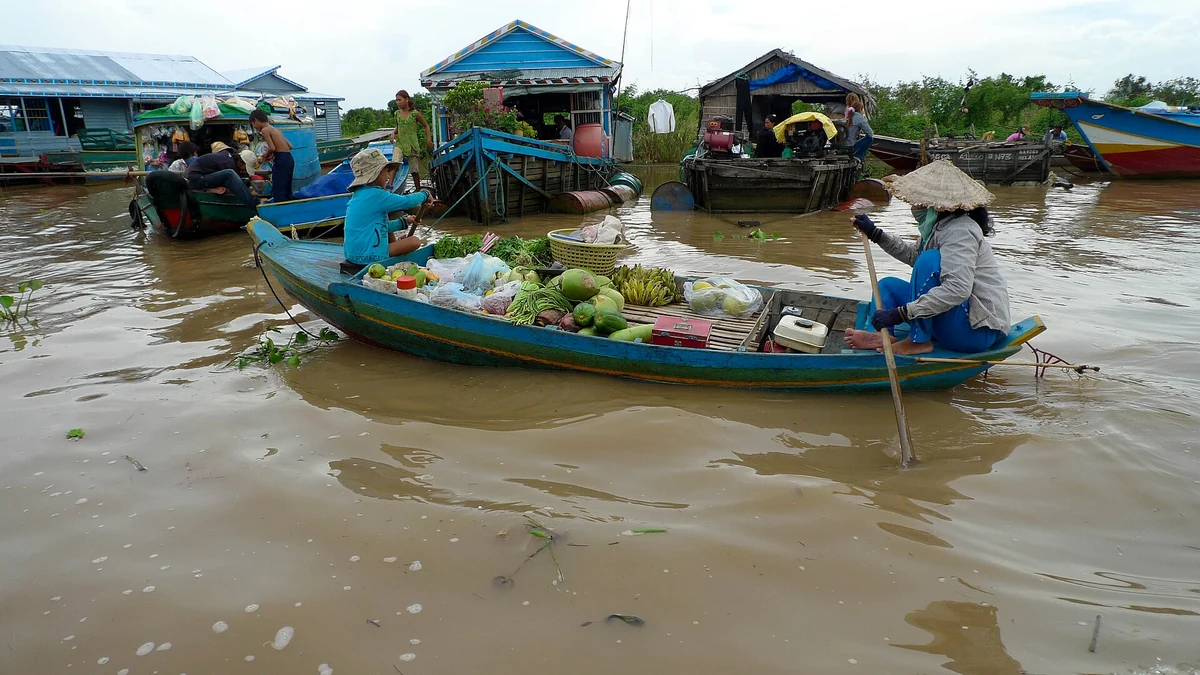
A boat selling produce beside floating houses on Tonle Sap lake. Photo: David Sim, CC BY 2.0, via Wikimedia Commons
Tonle Sap on an Angkor Wat Tour
Almost every catalog tour covers temples only. One trip adds the lake, and it is important to read what its price does and does not include before you book.
The One Catalog Trip That Includes the Lake
The Angkor Wat and Floating Village 2-Day Tour is a private two-day trip costing $235 per group of up to 10. Day one covers Angkor Wat at sunrise, Ta Prohm, Ta Keo, Ta Nei, Angkor Thom, the Terrace of the Elephants and the Bayon. Day two runs to Beng Mealea, the Kampong Phluk floating village, the Tonle Sap Great Lake and Roluos market. It carries a 5.0 rating from 130 reviews.
Read the exclusions carefully. The Angkor Pass is not in the price, as with every tour in the catalog. the checkout adds US$69 in extra charges on top of the $235, which is not broken down on the listing, and the exclusions list names the entrance fees and the admission fee and private boat ride to Tonle Sap and Kampong Phluk separately. The listing does not state the split between those items. Treat the $235 plus the $69 of added charges as the starting figure, since the listing does not say whether that $69 covers the entrance fees or the boat ride. Compare it against other multi-day options such as the Angkor Wat 2-Day Tour at $34 per person, which stays at the temples, or the Angkor Wat 3-Day Tour, to see what a day at the lake costs you in practice.
The Scams to Avoid
Wikivoyage is blunt about the lake trade. Chong Kneas, the closest village to Siem Reap, is described as being in a bad state for visitors, with established scam practices, and it warns that the same practices are beginning to show at Kampong Phluk. Boats and drivers are rented at the access points and may be priced per person or per boat, so agree the unit, the duration and the total before you step on board.
The official safeguard is simple. Chong Kneas boat-ride tickets are not sold online and must be bought at the official counter, where the packages come in small, medium and large boats with rates for national and international visitors. Buy there rather than from anyone who approaches you on the road. For scams at the temples themselves, the on your own section of the homepage and the Angkor Wat tickets guide cover the official channels.
Sources: Wikivoyage: Tonle Sap, Angkor Enterprise: Chong Kneas.
Tonle Sap Tips
A short list of things that make a lake trip smoother, each one drawn from the official ticketing rules and Wikivoyage.
Do
- Do buy Chong Kneas boat tickets at the official counter, because the Angkor Enterprise site states they are not sold online and only the counter sells the small, medium and large boat packages.
- Do agree whether your boat price is per person or per boat before boarding, because Wikivoyage notes that boats and drivers at the access points may be priced either way.
- Do go in the dry season months of November to April if birds are your goal, because Wikivoyage names that window as best as the receding water concentrates birdlife.
- Do budget separately for the boat ride on a tour, because the 2-day floating village tour excludes the admission fee and private boat ride to Tonle Sap and Kampong Phluk from its $235 price.
- Do check the water level for your month, because the lake sits at about 1 m deep at the end of the dry season and 9-14 m in the rains, which changes what each village looks like.
Don't
- Don't assume Chong Kneas is the best village just because it is closest, because Wikivoyage describes it as in a bad state for visitors with established scam practices.
- Don't accept a street-side ticket offer, because the official rule is counter purchase only for Chong Kneas boat rides.
- Don't expect one listed price for a village trip, because boat prices at the villages vary and are per person or per boat, and no official per-boat figure is published.
- Don't hand over a temple pass as a lake ticket, because Chong Kneas is listed by Angkor Enterprise as a separate area with its own boat packages, distinct from the Angkor zone.
Tonle Sap Questions
What is the largest lake in Cambodia called?
Tonle Sap. It swells to about 16,000 sq km in the wet season from about 2,500-3,000 sq km in the dry season. This guide covers the villages around it.
How far is Tonle Sap from Siem Reap?
The closest access point, Chong Kneas, is about 15 km south of Siem Reap by paved road, and Kampong Phluk is about 20 km south-east, both figures from Wikivoyage. Pairing the lake with the temples is easiest on a two-day trip such as the Angkor Wat and Floating Village 2-Day Tour.
How much is a Tonle Sap floating village boat trip?
It depends on the village. Wikivoyage's Siem Reap page lists a Kampong Phluk boat tour at US$25 per person, while boats at the access points may be priced per person or per boat. Official Chong Kneas packages are sold only at the counter, as the tickets guide explains for the temple-side equivalents.
When is the best time to visit Tonle Sap?
For birdlife, Wikivoyage names November to April, when the receding water concentrates the birds. For houses surrounded by water, the wet season of about May to October is stronger, when the lake deepens from about 1 m to 9-14 m. The when to go section above breaks the seasons down.
Are the Tonle Sap floating villages a scam?
The villages are real communities, but Wikivoyage warns that Chong Kneas is in a bad state for visitors with established scam practices, and that the same practices are beginning to show at Kampong Phluk. Buy official counter tickets, agree the price unit, and ask about other villages such as Kampong Khleang.
Does the floating village tour include the Angkor Pass?
No. The Angkor Wat and Floating Village 2-Day Tour excludes entrance fees, and the checkout adds US$69 in extra charges on top of the $235 per group, without stating the split. No catalog tour includes the Angkor Pass, as the cost breakdown page explains.
Is Tonle Sap a lake or a river?
Both. Tonle Sap is a lake connected to the Mekong by the 115-120 km Tonle Sap River, which flows into the lake for about six months and then reverses direction for the other six. See the lake section for the full mechanics of the reversing river.
How many people live on Tonle Sap?
About 1.2 million people live in the Tonle Sap area, many in floating and stilted villages on the lake itself, with schools, shops and even dentists on the water (International Business Times). Read more under life on the water.
Is it Tonle Sap or Tonlé Sap?
Both spellings name the same lake, and the name also covers the 115-120 km river that links it to the Mekong. Boat operators at Kampong Phluk and the other villages sell trips on it under either spelling.
Why is the water level falling?
The International Business Times reports the reverse flow from the Mekong reached its lowest level since 1997 in one recent season, and Wikipedia records a record-low July water level in 2020. Upstream dams and drought are blamed. This can make the dry-season lake look smaller than the photos, as the lake section explains.