 Angkor Wat Tours
Banteay Srei: the Citadel of Women, and How to Visit It
Banteay Srei is the small red sandstone temple about 25 km north-east of the main Angkor group by the official count (Wikivoyage gives 37 km from Siem Reap), and it sits on almost no tour itinerary. This guide covers its 967 consecration date, its courtier builders, the carvings that made it famous, the Malraux theft, what is roped off, the drive from Siem Reap, the north checkpoint rule and the Kbal Spean site 8 km further north. It also shows which tours actually stop here and what you pay beyond the tour price, because no tour in the comparison includes the Angkor Pass. For the main temples, see the Angkor Wat tours comparison.
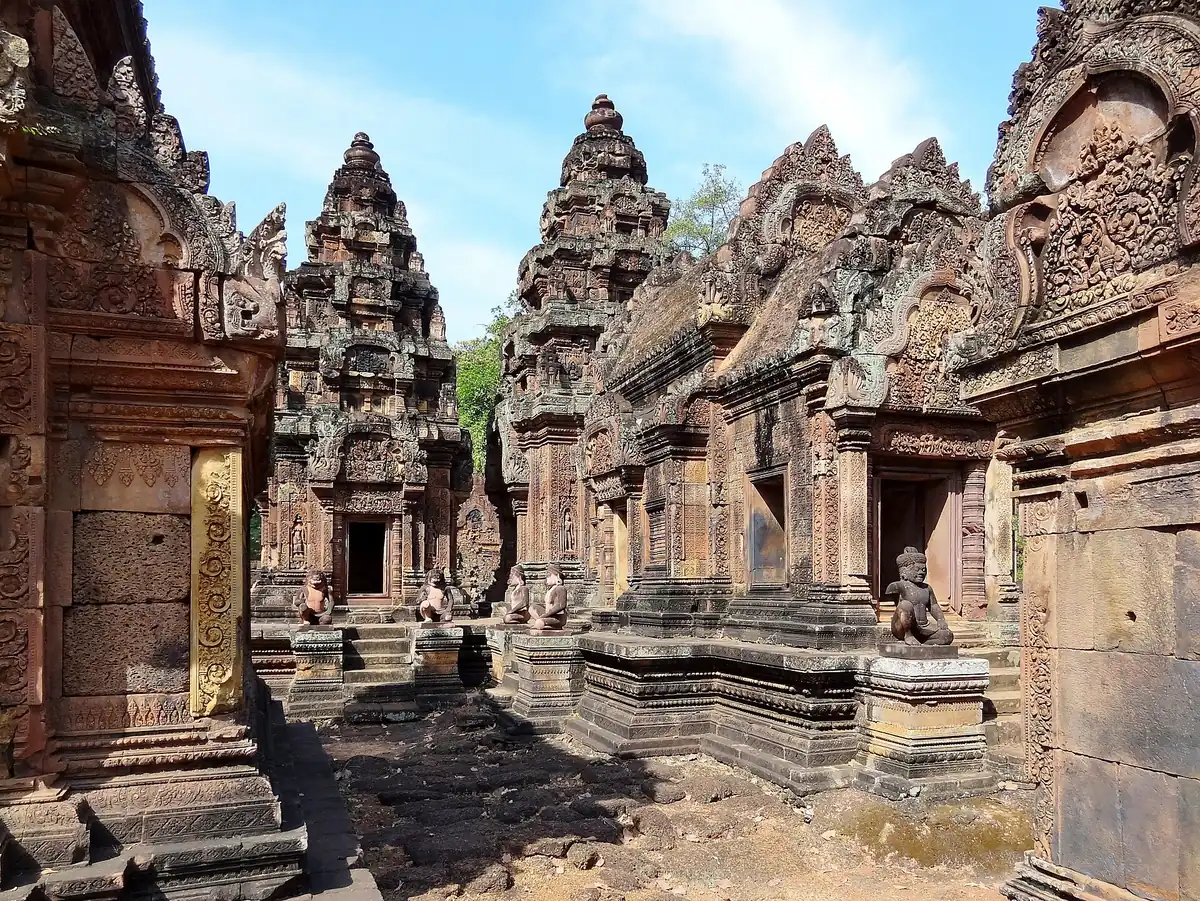
The central and southern towers of Banteay Srei in red sandstone. Photo: Olaf Tausch, CC BY 3.0, via Wikimedia Commons
Quick answer Banteay Srei in brief
Banteay Srei is a 10th-century Hindu temple about 25 km north-east of the main Angkor group by the official count (Wikivoyage says 37 km from Siem Reap), built of red sandstone and consecrated on 22 April 967. It is tiny: the outer enclosure measures 95 m by 110 m and the central tower stands 9.8 m high. Almost no day tour stops here. In the comparison only the Angkor Wat 3-Day Tour lists Banteay Srei, and the Angkor Pass is never in a tour price.
Key takeaways
- Only one tour in the comparison stops at Banteay Srei: the Angkor Wat 3-Day Tour, which lists it on day 2 at $241.75 per person with the pass extra.
- The one-day Angkor Pass costs $37 on the official ticket site, and entering from the Banteay Srei side, the north checkpoint, allows only 1-day passes.
- See how every tour price compares with the price after the pass on the Angkor Wat tours from Siem Reap homepage section.
- Combine the temple with Kbal Spean, 8 km further north, which has its own $5 pass, or push on to Beng Mealea.
The Citadel of Women
Banteay Srei is the smallest and the most finely carved of the major Angkor temples, and the only one founded by courtiers rather than a king.
The Date and the Builders
Banteay Srei was consecrated on 22 April 967, which makes it far older than Angkor Wat, begun in the early 12th century. It was founded by two courtiers, Vishnukumara and Yajnavaraha, counsellors to the king Rajendravarman II. A king funded none of it. The temple was originally called Tribhuvanamaheshvara, a name honouring the god Shiva. The name everyone uses today, Banteay Srei, is usually translated Citadel of Women, and travelers also spell it Banteay Srey. The temple was rediscovered in 1914. The temple was restored in the 1930s in the first major use of anastylosis at Angkor, the method of reassembling fallen blocks in their original positions. A Cambodian-Swiss project later built a drainage system there between 2000 and 2003 to protect the soft stone.
Source: Wikipedia, Banteay Srei.
The Red Sandstone and the Scale
The temple is built mostly of a hard red sandstone that gives Banteay Srei its pink-red colour, with brick and laterite used for the enclosure walls. The scale is the second surprise. The outer enclosure measures only 95 m by 110 m, the approach causeway is 67 m long, the central tower rises just 9.8 m, and the sanctuary doorway is a mere 1.08 m high. Visitors tower over the buildings. It is small by Angkor standards. Give yourself the time to look closely, because the whole point of Banteay Srei is detail at eye level.
Source: Wikipedia, Banteay Srei.
Abandonment and Looting
Just Siem Reap dates the abandonment to around the 15th to 16th century, and Wikipedia records the rediscovery in 1914. Just Siem Reap also records looting during the Khmer Rouge years. The 1923 theft by Andre Malraux of four devatas, who was arrested and whose loot was returned, was only the most famous incident.
The 1930s anastylosis restoration, the first major use of that method at Angkor, rebuilt the temple from fallen blocks, and a Cambodian-Swiss project built a drainage system in 2000-2003. Wikipedia notes most of the sanctuary's kneeling guardians are now replicas.
Sources: Wikipedia, Banteay Srei, Angkor Enterprise.
The Carvings
The pediments and devatas of Banteay Srei are the finest carving in the Angkor park, and part of the temple is roped off to keep them that way.
Pediments and Devatas
The red sandstone of Banteay Srei carries deep, sharp relief carving on nearly every surface. The temple pediments, the carved panels above the doorways, are famous for their narrative scenes from Hindu myth, framed by dense ornament. Wall panels hold rows of devatas, female guardian figures, and small niches once held carved figures set against a background of fine foliage. The doorways are small, the sanctuary doorway measures just 1.08 m high, so you read the temple at close range.
Source: Wikipedia, Banteay Srei.
The Malraux Theft and What Is Roped Off
Banteay Srei was rediscovered in 1914, and its fame brought trouble quickly. In 1923 the French writer André Malraux stole four devatas from the temple and was arrested, and the figures were returned. According to Wikipedia, the inner temples at Banteay Srei are roped off and visitors view them from outside the ropes, and the first enclosure reopened in 2010 after work on the site. In practice that means you cannot walk into the central sanctuary area: you circle it and look at the towers and their carving from a short distance. Keep to the marked paths and do not lean over the barriers for a photo.
Source: Wikipedia, Banteay Srei.
Named Scenes and Where They Stand
The carving is not generic decoration. The outer gopura shows Indra on the three-headed elephant Airavata. The third enclosure holds the abduction of Sita, and its Sunda and Upasunda pediment now hangs in the Guimet Museum in Paris.
The second enclosure shows the duel of Vali and Sugriva, Shiva as Nataraja and the Tamil saint Karaikkal Ammaiyar. The southern library carries Ravana shaking Mount Kailasha and Shiva burning Kamadeva, the northern library Indra's rain at Khandava Forest and Krishna killing Kamsa. The sanctuary's six stairways have kneeling animal-headed guardians, and most are replicas.
Because the inner parts stay roped off, some pieces can only be seen from a distance. More detail sits in the scenes guide below on this page.
Sources: Wikipedia, Banteay Srei, Wikivoyage, Angkor.
Scenes to Find, Enclosure by Enclosure
Banteay Srei rewards a slow walk in one fixed order. Each pediment carries a named story, and knowing which one sits where makes the visit far easier.
The Outer Gopura and the Third Enclosure
Enter by the outer gopura. Its east pediment shows Indra riding the three-headed elephant Airavata. From there a causeway 67 m long leads to the third enclosure, which measures 95 m by 110 m. In this enclosure a Ramayana pediment shows the demon Maricha seizing Sita, while the west-facing Mahabharata pediment of Sunda and Upasunda is no longer on site. It was taken to the Guimet Museum in Paris. Some pediments also lie on the ground among the ruins, so look down as well as up.
For how this site fits the Angkor circuits, see the Angkor Wat map guide.
| Location | Scene | Where it is now |
|---|---|---|
| Outer gopura, east pediment | Indra on the elephant Airavata | In place |
| Third enclosure | Maricha seizing Sita (Ramayana) | In place |
| Third enclosure, west face | Sunda and Upasunda (Mahabharata) | Guimet Museum, Paris |
The Second Enclosure, Libraries and Sanctuary
The second enclosure has walls of laterite at 38 m by 42 m and brick at 24 m by 24 m. On its western gopura the duel of Vali and Sugriva is carved, while the eastern pediment shows Shiva as Nataraja, the dancing lord. The west-facing pediment beside him shows the Tamil saint Karaikkal Ammaiyar.
The two libraries come next. The southern library shows Ravana shaking Mount Kailasha under Shiva and Parvati on its east face and Shiva burning Kamadeva on its west face. The northern library shows Indra's rain at Khandava Forest and Krishna killing Kamsa.
The sanctuary itself stands on a T-shaped platform 0.9 m high with six stairways guarded by kneeling figures with animal heads, and most of those guardians are now replicas.
| Building | East face | West face |
|---|---|---|
| Southern library | Ravana shaking Mount Kailasha | Shiva burning Kamadeva |
| Northern library | Indra's rain at Khandava Forest | Krishna killing Kamsa |
| Second enclosure | Shiva as Nataraja (eastern pediment) | Duel of Vali and Sugriva (western gopura) and Karaikkal Ammaiyar (west-facing pediment) |
Source: Wikipedia.
Getting There
Banteay Srei sits outside the main temple cluster, the drive takes a chunk of the day, and the north checkpoint has its own rule.
The Distance and the Drive
The sources disagree on the distance, so here are both. Wikipedia and the official Angkor Enterprise explore page put Banteay Srei about 25 km north-east of the main Angkor group, and Wikipedia's Siem Reap page puts it about 30 km north-east of Siem Reap. Wikivoyage gives 37 km from Siem Reap and 37 km north of Angkor Wat. Wikivoyage calls it worth a half-day trip. Drivers commonly charge about US$10 extra for including Banteay Srei on a day's run (Wikivoyage). The road passes through countryside north of the main cluster, and you can add stops such as the Cambodia Landmine Museum, which Wikipedia places about 25 km north of Siem Reap on the same side of town. Wikivoyage notes that combining Banteay Srei, Kbal Spean and Beng Mealea in one day means roughly 5 hours of travel on rough roads, so pick two stops, not three.
Sources: Angkor Enterprise, Wikivoyage, Angkor.
The North Checkpoint Rule and Your Pass
Banteay Srei sits inside the Angkor ticket system, so you need an Angkor Pass. The official Angkor Enterprise site sells the 1-day pass for US$37, the 3-day pass for US$62 and the 7-day pass for US$72, and the pass covers access to 50+ temples in the Angkor Temples Park. Passes are sold online at ticket.angkorenterprise.gov.kh, and children under 12 enter free with their passport. Now the rule that catches people: Wikivoyage reports that entering the park from the Banteay Srei side, the north checkpoint, allows only 1-day passes. If you plan to arrive via Banteay Srei on a multi-day pass, enter through the main checkpoints instead. Park entry runs from 5:00 AM to 6:30 PM on all three passes, and a pass bought after 5:00 PM counts from the next day. Your photo is printed on the pass, so it cannot be shared. Children under 12 go free, and Cambodian citizens and K visa holders enter free (Wikivoyage).
Sources: Angkor Enterprise, Wikivoyage, Angkor.
Kbal Spean, 8 Km Further North
Kbal Spean, the riverbed of carved lingas, lies 8 km north of Banteay Srei and about 45 km from Siem Reap (Wikivoyage). The site holds roughly 1,000 lingas carved into a 150 m stretch of riverbed, each about 25 cm square, with carvings dating to the 11th to 12th centuries. It was found by Jean Boulbet in 1969. Getting to the carvings means a walk: Wikipedia says the walk to the first site, a waterfall, is about 40 minutes and roughly 2 km uphill, while Wikivoyage gives 1,500 m, so plan on a short forest hike. Kbal Spean has its own ticket, a separate 1-day pass for US$5 sold on the official site, with entry from 6:00 AM to 6:30 PM. Wikivoyage notes the dry months of January and February leave little water, which makes the carvings easier to see. If you want more carved water and mountain scenery beyond this pair, that is the territory of Phnom Kulen, a separate mountain plateau day.
Sources: Angkor Enterprise, Wikipedia, Kbal Spean.
Sources: Angkor Enterprise, Wikivoyage, Angkor, Wikipedia, Kbal Spean.
How Long to Stay and What Combines With It
Banteay Srei is compact, so the visit itself is short and the drive takes the bigger share of the day. Plan the neighbours into the same trip.
How Much Time to Allow
Just Siem Reap suggests 1-2 hours minimum at the temple, which suits a site whose outer enclosure is only 95 m by 110 m and whose central tower stands 9.8 m tall. Wikivoyage calls the whole trip worth a half-day from Siem Reap once the drive is counted. Just Siem Reap says crowds are thinner here than at the temples near Angkor Wat.
The first enclosure reopened in 2010, but parts of the inner temple stay roped off. Just Siem Reap puts the cycle at roughly 35 km each way, so start at dawn to beat the heat.
| Stop | Distance from Banteay Srei | Source |
|---|---|---|
| Kbal Spean | 8 km further north (Wikivoyage) or 13.1 km by road (Just Siem Reap) | Wikivoyage and Just Siem Reap |
| Phnom Kulen | 10.7 km by road | Just Siem Reap |
| Banteay Samre | 21.1 km by road | Just Siem Reap |
Good Stops on the Same Drive
The distances above come from two guides that disagree on Kbal Spean, so check the route with your driver before you set off. Kbal Spean carries its own separate pass of US$5, with entry from 6:00 AM to 6:30 PM. Banteay Samre is the third stop in the table above, and the Angkor Wat 3-Day Tour visits it on day 2.
Wikipedia puts the Cambodia Landmine Museum about 25 km north of Siem Reap. Wikivoyage warns that combining Banteay Srei, Kbal Spean and Beng Mealea means about 5 hours of travel on rough roads. For the temple's own story and carvings, read the Banteay Srei guide, and for entry prices see Angkor Wat tickets.
Source: Wikivoyage, Just Siem Reap, Angkor Enterprise.
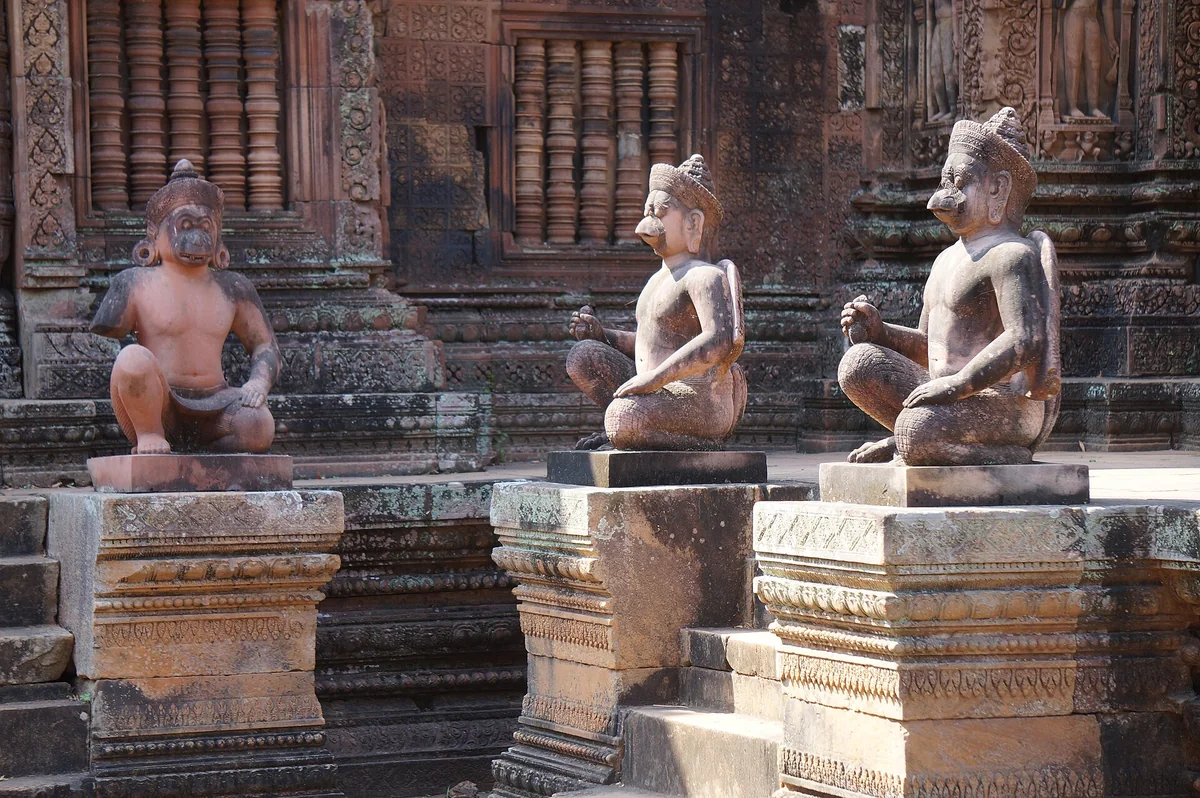
Guardian figures flanking the steps of the Banteay Srei sanctuary and mandapa. Photo: PIERRE ANDRE LECLERCQ, CC BY-SA 4.0, via Wikimedia Commons
Tours That Include Banteay Srei
Almost no day trip from Siem Reap lists Banteay Srei, so before you book, check the itinerary rather than the title.
The One Tour That Stops Here
Exactly one tour in the comparison includes Banteay Srei: the private Angkor Wat 3-Day Tour, which puts it on day 2 between the big-circuit temples and Banteay Samre and Banteay Kdei. The price below is the card price on the tthis page. The Angkor Pass is not in any tour price in the catalog, so the pass line is what you hand over separately, either online before the trip or on day 1 with the guide.
For single-day Banteay Srei trips, no catalog tour lists it, so a driver is the other option, and Wikivoyage reports about US$10 extra on a driver's day rate. If you want other outer-temple days, the Koh Ker and Beng Mealea tour page covers that direction, and Beng Mealea has its own guide at Beng Mealea. Start at the Angkor Wat tours homepage to see the full comparison.
| Tour | Price | Days | You pay |
|---|---|---|---|
| Angkor Wat 3-Day Tour (private, Banteay Srei on day 2) | $241.75 | 3 days | $303.75 (includes the $62 three-day Angkor Pass added at checkout) |
What the Pass and the Tour Each Cost
The figures in the table come straight from the tour listing and from the official ticket site. The tour price of $241.75 covers three private days of guiding and an air-conditioned vehicle with hotel pickup, with lunches from about US$5 per dish extra. The three-day Angkor Pass at US$62 per person, added at checkout, is the mandatory extra, and the platform's total for tour plus pass is $303.75.
Do not read the $62 as buying Kbal Spean or Beng Mealea tickets: Kbal Spean carries its own $5 pass on the official site, and the sources conflict on Beng Mealea, with the official site selling a separate pass and Wikivoyage saying it is included in the Angkor Pass. For the arithmetic on every tour price against its pass total, see the price comparison on the homepage.
Sources: Angkor Enterprise, Wikivoyage, Angkor.
Banteay Srei: Common Questions
Is Banteay Srei worth visiting?
The carving is the finest in the Angkor park and the red sandstone colour is unlike any of the big grey temples, and Wikivoyage calls the trip worth a half day. The trade-off is the drive, about 25 to 37 km each way depending on the source, and the fact that the inner temples are roped off. Read the full detail in the Citadel of Women section above.
Is Banteay Srei part of Angkor Wat?
No. Banteay Srei is a separate 10th-century temple about 25 km north-east of the main Angkor group by the official count (Wikivoyage says 37 km from Siem Reap), built by courtiers and consecrated on 22 April 967, long before Angkor Wat. It does sit inside the Angkor ticket system, so the Angkor Pass covers it, and the official site lists it among the 50+ temples of the Angkor Temples Park. The Angkor Wat guide covers the main temple.
How do you visit Banteay Srei?
You need an Angkor Pass, $37 for the one-day ticket on the official site, and you can drive out by tuk-tuk or car, with Wikivoyage reporting drivers charging about US$10 extra for the stop. Watch the north checkpoint: entering the park from the Banteay Srei side allows only 1-day passes. In the comparison only the Angkor Wat 3-Day Tour lists Banteay Srei on its itinerary.
Why was Banteay Srei built?
It was a Hindu temple dedicated to Shiva, originally named Tribhuvanamaheshvara, founded by the courtiers Vishnukumara and Yajnavaraha, counsellors to King Rajendravarman II, and consecrated on 22 April 967. Unlike Angkor Wat or the Bayon temple, no king commissioned it.
What is Banteay Srei famous for?
Three things: the deep relief carving on its red sandstone pediments and devata panels, the 1923 theft of four devatas by André Malraux, who was arrested and the figures returned, and the fact that the inner temples are now roped off so visitors view the sanctuary from outside the barriers. See the carvings section for the full story.
Can you combine Banteay Srei with other sights in one day?
Kbal Spean sits 8 km further north and pairs naturally with it, though it needs its own $5 pass and a walk of about 40 minutes and roughly 2 km uphill to the first site per Wikipedia (Wikivoyage says 1,500 m). Wikivoyage warns that adding Beng Mealea to the same day means about 5 hours on rough roads, so pick two stops. Beng Mealea has its own page at Beng Mealea.
Why is Banteay Srei called the pink temple?
Wikipedia says the temple is built mostly of hard red sandstone, which is why guides call it the pink temple. Tienchiu says the hard stone carves like wood and weathers better. See the full Banteay Srei guide.
How long do you need at Banteay Srei?
Just Siem Reap suggests 1-2 hours minimum at the temple, and Wikivoyage calls the trip a half-day from Siem Reap once you count the drive. Wikivoyage puts it at 37 km from Siem Reap, while Wikipedia and the official site say about 25 km north-east of the main Angkor group. The tour that stops here, the Angkor Wat 3-Day Tour, gives it a scheduled slot on day 2.