 Angkor Wat Tours
Siem Reap: Cambodia's Base Town for Angkor Wat
Siem Reap is the town travelers use as their base for the Angkor temples, and it sits about 6 km from Angkor Wat itself, roughly 20 minutes by car or motorbike according to Wikivoyage. This guide covers where the town is, which areas suit which traveller, what to do on your rest days, what things cost, and how the money and the safety advice work on the ground. The town had 245,494 residents at the 2019 census, making it Cambodia's second-largest city, and it exists in practice around one thing: the temples. If you have not yet sorted your Angkor Wat tickets, start there, because the Angkor Pass is not in any tour price on this site. For the flights side, the airport page covers the transfer from Siem Reap airport, which now sits 50 km east of town. When you are ready to pick a temple day, the comparisons of Angkor Wat tours at the homepage put every option side by side.
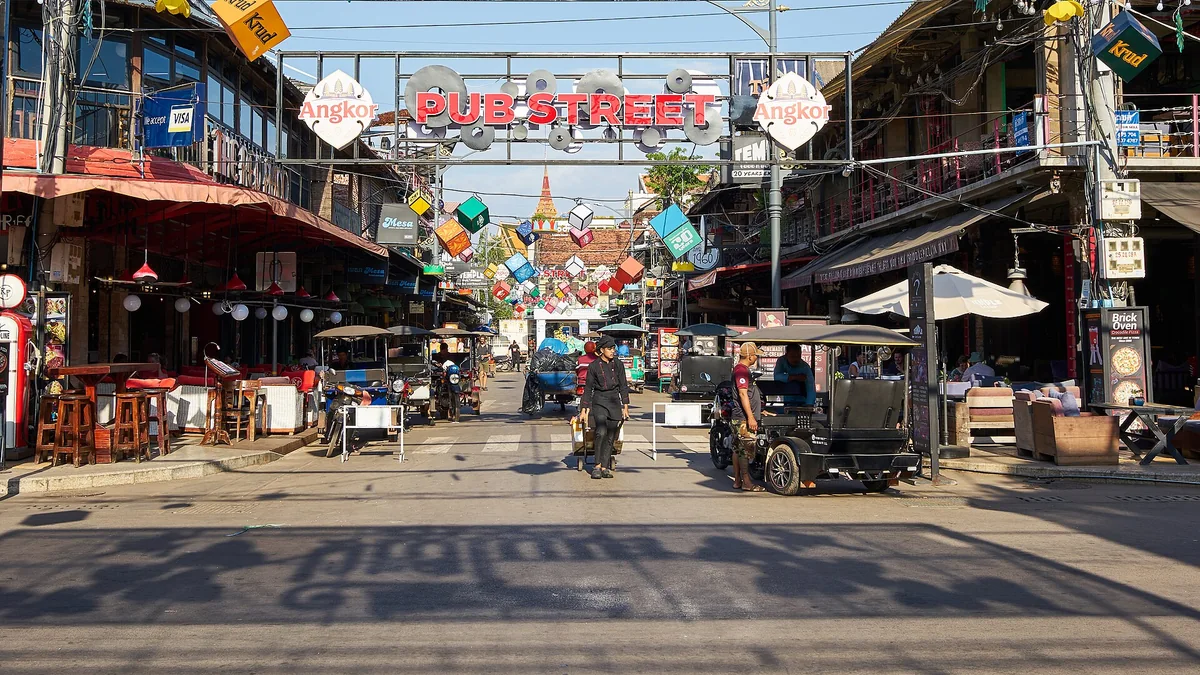
The Pub Street sign over the road in Siem Reap, with tuk-tuks and cafes below. Photo: Radek Kucharski from Warsaw, Poland, CC BY 2.0, via Wikimedia Commons
Quick answer Siem Reap in short
Siem Reap is Cambodia's second-largest city, with 245,494 residents at the 2019 census, and Angkor Wat lies about 6 km away, roughly 20 minutes by car or motorbike. A short tuk-tuk ride in town costs about $1.25 (5,000 riel) and a full-day tuk-tuk hire for the temples about $20. US dollars are the working currency, with riel for small change at about 4,000 to the dollar. Book a hotel near the Old Market or Wat Bo Road, buy the Angkor Pass separately, and leave one evening for the Phare circus.
Key takeaways
- The town has its own sights for temple-free days, from the Angkor National Museum to the Phare circus and the APOPO visitor centre.
- Every Angkor Wat sunrise tour starts from a Siem Reap hotel, and none includes the Angkor Pass, which costs $37 for one day on top.
- Where you sleep matters less than you think, because the temples are only 6 km away: compare the areas in Where to Stay in Siem Reap.
- A private tuk-tuk day such as the Angkor Wat Private Tuk-Tuk Tour costs $20 per group of up to 3, with the Angkor Pass paid separately.
Siem Reap and the Temples
Siem Reap is the capital of Siem Reap province in northwestern Cambodia, and the Siem Reap River runs straight through the city. Nearly every visitor arrives for Angkor and finds a working town of cafes, markets and hotels built around that one purpose.
How Far to the Temples
Wikivoyage puts Siem Reap at about 6 km from Angkor Wat, which is roughly 20 minutes by car or motorbike. The official APSARA ticket office sits just off the highway from town, a couple of kilometres from the southern park entrance, where you can buy the Angkor Pass if you have not bought it online. The pass is never part of a tour price: on the Angkor Wat Small-Group Sunrise Tour, for example, the $15 tour price becomes $52 once the $37 one-day pass is added. If you have longer, Banteay Srei lies about 30 km north-east of the city on Wikipedia's figure (Wikivoyage gives 37 km) and Phnom Kulen National Park about 48 km away, while Beng Mealea is 80 km east, about 1.5 hours by car on Wikivoyage's figures.
The airport is a different story. Siem Reap-Angkor International Airport (SAI) opened on 16 October 2023 about 50 km east of the city, in Soutr Nikom District, and the old airport 7 km northwest of town is closed. Hello Angkor lists a fixed airport taxi at about $35 for a car of 1-3 passengers and about $45 for a minivan, while another source gives $25-30, and the shuttle bus is $8 one way.
Getting Around Town
The tuk-tuk is the town's default transport and Wikipedia estimates Siem Reap had about 6,000 tuk-tuk drivers in 2019. Wikivoyage lists a short trip in town at about $1.25 (5,000 riel), a motodop motorbike taxi at about $0.50, and a full-day hire for the temples at about $20, with sunrise or sunset starts a bit more. A second source, Wikivoyage's Angkor page, prices temple days at about $15 for the main temples and $20-30 for outlying temples, with a sunrise start adding about $3. Nomadic Matt puts a full day at about $25 for 3-4 people. Plan on $15-25 depending on the route and your bargaining.
Bicycle rental runs $1-8 a day depending on quality, and shops mostly do not open before 07:00. The Grab and PassApp apps can summon tuk-tuks. Helmets are legally required for motorbike riders, and inside the park drivers must wear a numbered vest.
A guided day does the driving for you. The Angkor Wat Full-Day Tour with Sunset runs 9 hours from $14 per person, the Angkor Pass of $37 extra, for $51 in total. On your own, the homepage's going-on-your-own section lays out the cost sums.
Seasons and Climate
Siem Reap's average high never falls below 30 C in any month. January averages a high of 31.7 C with 3.7 mm of rain, and April is the hottest month at an average high of 35.8 C. The record high is 41.2 C. The wet season runs from May to October, and September is the wettest month at 287.7 mm of rain. The town averages about 1,406 mm of rain a year over about 124 rainy days.
The temple day starts before dawn in any season: the sun rises around 6:31 am in mid January and as early as 5:37 am in mid June, which is why listed sunrise pickups run from 4:00 to 4:45 AM.
Sources: Wikipedia, Wikivoyage, Wikivoyage Angkor.
Where to Stay in Siem Reap
The town is compact and Angkor Wat is only about 6 km from the centre, so the choice is mostly about atmosphere and price rather than distance. Wikivoyage sorts the accommodation into three clusters: big hotels west of the centre, hostels near the Old Market, and boutique hotels along Wat Bo Road. The table compares them and where each sits relative to Angkor Wat.
The Main Areas
The larger hotels mostly line National Highway 6 west of the centre, which suits travelers who want pools, space and quiet over walkable nightlife. Backpacker hostels cluster around the Old Market, putting Pub Street and the night market on the doorstep at the lowest prices. Boutique hotels sit along Wat Bo Road on the far side of the river, a short walk from the centre with more calm. For the classic address, Raffles Grand Hotel d'Angkor stands at 1 Vithei Charles de Gaulle, on the road toward the temples. Wikivoyage dates its opening to 1932 while Wikipedia gives 1929, so the sources differ on the exact date.
There is a fourth practical option: the area along the road toward the temples, where you trade evening walks into town for the shortest morning run to the ticket gate. Since Angkor Wat is only 6 km from the centre, no area saves you more than a few minutes.
Which Area Suits You
If this is your first trip and the evenings matter as much as the temples, stay near the Old Market. If you are traveling as a couple and want quieter streets and restaurants, Wat Bo Road fits. Families and pool days suit the Highway 6 hotels.
Early risers on sunrise tours are picked up at their hotel door anyway: the Angkor Wat Highlights Sunrise Tour collects guests between 4:15 AM and 4:35 AM wherever they stay in town. That tour costs $19 per person plus the $37 Angkor Pass, $56 in total.
Hotel Areas Side by Side
The areas below follow Wikivoyage's notes on where Siem Reap's hotels cluster, with what each suits and how it sits for the drive out to Angkor Wat.
| Area | Good for | To Angkor Wat |
|---|---|---|
| Old Market and Pub Street | Backpackers, nightlife, cheapest beds and hostels | About 6 km from the centre, roughly 20 minutes by car or motorbike |
| The river and Wat Bo Road | Couples and quiet boutique hotels | About 6 km from the centre, roughly 20 minutes by car or motorbike |
| National Highway 6 west | Big hotels, pools, families | West of the centre, no distance published |
| Road toward the temples | Shortest morning drive, resort feel | Along the road toward the ticket office and the park |
Sources: Wikivoyage, Wikivoyage Angkor.
Things to Do in Siem Reap
Most temple itineraries leave afternoons and rest days free, and Siem Reap fills them well. The town's sights are spread between the centre and the road toward Banteay Srei, and almost all list their entry prices openly, which the table sets out. Figures come from each attraction's own site where it has one, and from Wikivoyage where marked.
Daytime Sights and Prices
The Angkor National Museum on Vithei Preah Sihanouk Avenue opened on 12 November 2007 and works well the day before your first temple day. Its own site lists hours of 08:30-18:00 from April to September and 08:30-18:30 from October to March. Its site lists no price, and Wikivoyage lists entry at $12 plus $5 for an audio guide. The APOPO visitor centre, where trained rats clear landmines, is open daily 8:30 am to 5:00 pm with the last tour at 4:30 pm, costs $10 per person, with children under 10 free, and sits about 10 minutes by tuk-tuk from downtown. APOPO asks visitors to book online in advance.
On the road to Banteay Srei, the Cambodia Landmine Museum charges $7 for foreign adults and $2.50 for Khmer adults, with children under 13 free, open daily 7:30 AM to 5:30 PM. Wikivoyage separately lists $5, so the sources differ. Wikivoyage also lists the War Museum at $5, open 08:00-17:30, and a free guided workshop tour at Artisans d'Angkor, open daily 07:30-17:30, where silk and stone carving workshops end in showrooms.
Sights and Their Prices
Prices and hours below come from each venue's own site where it publishes them, and from Wikivoyage where it does not, attributed in the table.
| Place | What it is | Price |
|---|---|---|
| Angkor National Museum | Museum of Angkor-era art and history, audio guides in eight languages | $12 entry plus $5 audio guide (Wikivoyage, museum site lists no price) |
| Phare, The Cambodian Circus | Nightly 1-hour circus show with live music | Section C $18 adult, section A $38 adult, children 5-11 $10-18 |
| APOPO visitor centre | Mine-detection rat demos, about 10 min by tuk-tuk from downtown | $10 per person, children under 10 free |
| Cambodia Landmine Museum | Landmine history museum on the Banteay Srei road | $7 foreign adults (museum site), $5 per Wikivoyage |
| War Museum | War-era vehicles and exhibits | $5 (Wikivoyage) |
| Artisans Angkor | Free guided craft workshop tour | Free |
| Old Market | Covered market for souvenirs and food | Bargaining expected |
Markets and Bargaining
The Old Market is the town's covered market and its prices are tourist-oriented. Wikivoyage suggests opening at about 20% of the asking price for art or cloth and settling somewhere in between. The Angkor Night Market runs in the evenings in the same quarter.
Expect to pay in dollars and receive riel coins and small notes as change.
Evenings: Pub Street and the Circus
Pub Street is the town's evening centre, a strip of bars and food stalls next to the Old Market. The structured alternative is Phare, The Cambodian Circus, which runs a nightly 8:00 pm show of about 1 hour year-round, plus 5:00 pm matinees on Wednesdays, Fridays and Sundays in the high season, with pre-show food and shopping from 5:30 pm. Tickets are priced by section: A (reserved) $38 adult and $18 child, B $28 and $15, C $18 and $10, with children aged 5-11.
A temple-free morning can become a second temple day. The Private Angkor Temple Highlights Tour runs 7 hours from $31 per person, with the $37 Angkor ticket paid onsite, $68 in total.
Day Trips Beyond the City
Wikivoyage prices several day trips outside the temples. The Cambodia Landmine Museum on the road to Banteay Srei charges US$7 for foreign adults per its own site, though Wikivoyage lists US$5, and children under 13 go free. The War Museum is listed at US$5, open 08:00-17:30, and a free guided workshop tour runs at Artisans Angkor daily 07:30-17:30.
Kampong Phluk on Tonle Sap is a boat day, and Phnom Kulen National Park lies about 48 km north of the city. Distances and passes for the far temples are covered on the Koh Ker, Beng Mealea and Phnom Kulen pages.
Sources: Angkor National Museum, Phare, APOPO, Cambodia Landmine Museum, Wikivoyage.
Where to Eat in Siem Reap
Eating is cheap by Western standards and spread across several quarters. Wikivoyage names five areas and three price tiers per person.
Eating Areas and Price Tiers
Wikivoyage lists the eating areas as the Old Market, Kandal Village, Taphul Road, Wat Bo Village and Wat Damnak Village. Its meal tiers per person with a soft drink are simple: under $5 counts as budget, $5-10 is mid-range and over $10 is a splurge. For a full day of temples first, the Angkor Wat Full-Day Tour with Sunset has lunch paid at a local restaurant on top of the $14 tour price.
Dinner fits well after a Phare show or an evening on Pub Street.
Source: Wikivoyage Siem Reap.
Tonle Sap and the Floating Villages
The great lake south of the city is the classic day off from the temples. Two villages close to Siem Reap make easy trips.
Kampong Phluk and Chong Kneas
Kampong Phluk sits about 20 km south-east of Siem Reap, according to Wikivoyage. Experience Travel Group describes the stilted village soaring above the water in the dry season and sitting on top of it once the rainy season fills the lake. Wikivoyage lists a Kampong Phluk floating village boat tour at $25 per person. Agree the boat cost before you set off, because it is a separate fee that drivers may not mention until you arrive.
Chong Kneas is closer, about 15 km south of the city by paved road, but Wikivoyage carries a scam warning for it. Agree the price in advance and buy the Chong Kneas boat ticket at the counter rather than through a middleman.
The Angkor Wat and Floating Village 2-Day Tour pairs a temple day with Beng Mealea and the Kampong Phluk floating village on day two, with the boat fee listed as extra. More lake detail is on the Tonle Sap page.
Source: Wikivoyage Siem Reap, Wikivoyage Tonlé Sap, Experience Travel Group.
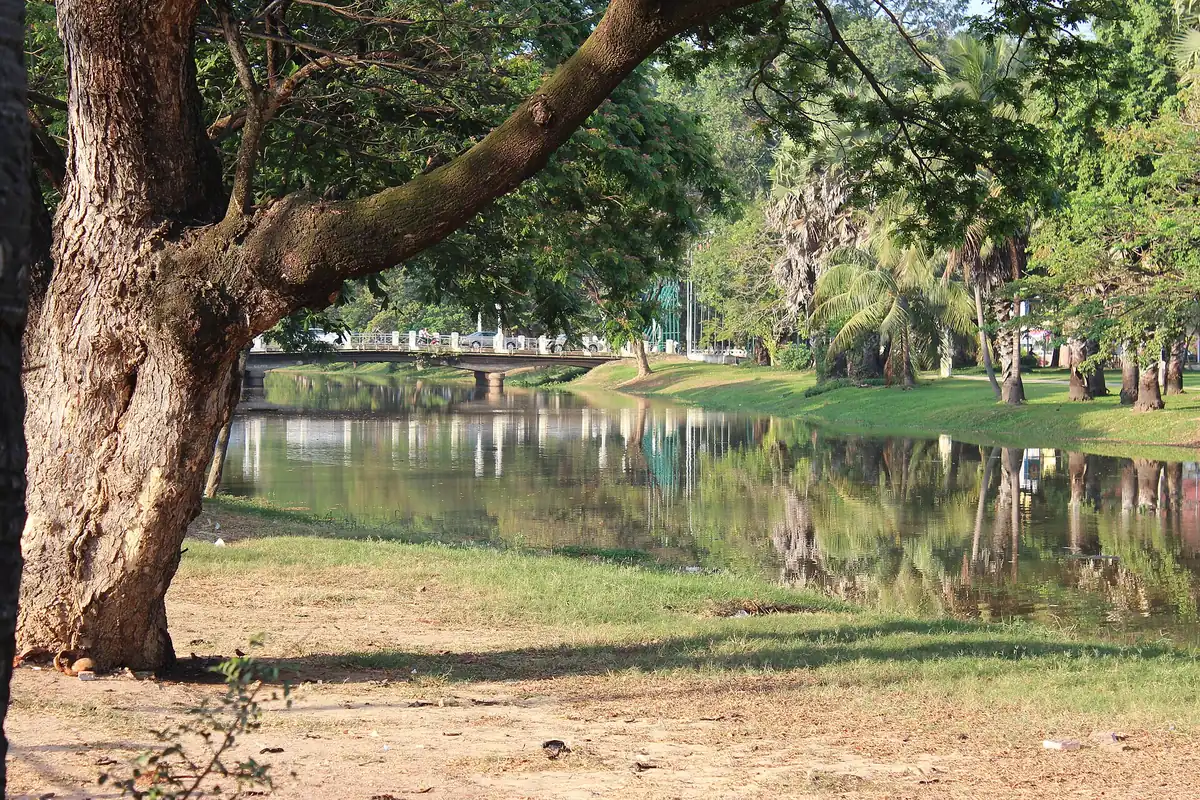
The Siem Reap River lined with trees and a bridge in the distance. Photo: Uhooep, CC BY-SA 4.0, via Wikimedia Commons
Money, Safety and Getting Around
Siem Reap runs on US dollars with riel underneath for small change, and the practical risks are petty theft and road safety rather than anything aimed at visitors. The figures below come from Wikivoyage and the FCDO travel advice.
Dollars and Riel
US dollars are widely used in the city and tourist areas, and ATMs dispense dollars. Wikivoyage puts $1 at about 4,000 riel, with the central bank rate near 4,100, and the riel is pegged unofficially at about 4,100 per dollar while shops commonly use 4,000. Riel is used only for small amounts, and change under a dollar usually arrives in riel. ATMs dispense up to $500 per withdrawal with a $5 fee, usually as $50 and $20 notes.
Two money warnings matter. Torn dollar bills may be refused, so keep your notes clean and unfold them. Fake $50 and $100 notes exist in circulation, including notes from ATMs, and the FCDO says fake dollar bills have been given as change in Cambodia. Check larger notes when you receive them.
Bag Snatching and Tuk-tuks
The FCDO says most theft in Cambodia involves motorbike thieves cutting bag straps, so carry bags on the side of your body away from the road, never on the roadside shoulder. Its advice for tuk-tuks is specific: use tuk-tuks with metal grills on the back and sides where possible, as they give some protection against bag snatching.
Roads and Helmets
The FCDO considers motorcycle taxis dangerous and says travel after dark significantly increases accident risk. Helmets are legally required for motorbike riders in Cambodia, so if you rent a scooter or ride a motodop, wear one. Inside the Angkor park, drivers and riders must also wear a numbered vest.
In town the tuk-tuk remains the sane default, and at 6 km from Angkor Wat the main temples are a short ride away.
Visas and Arrival
The tourist visa on arrival costs $30 and allows up to 30 days, and the tourist e-visa also costs $30, single entry, applied for online at least 4 days ahead. Wikivoyage warns that border staff often ask $35-40 for the visa on arrival, so the e-visa avoids the haggling. Air arrivals must also complete the free Cambodia e-arrival card online at arrival.gov.kh within 7 days before arrival.
A tourist visa extension in Phnom Penh costs $30 and is allowed once.
What Things Cost
The table collects the day-to-day prices from the sources, so you can budget the town and the temple days together. Tuk-tuk day figures differ by source and both are shown.
Costs at a Glance
Everyday costs below come from Wikivoyage and the official sites named in the last column, so you can see where each figure comes from.
| Item | Price | Source |
|---|---|---|
| Short tuk-tuk ride in town | About $1.25 (5,000 riel) | Wikivoyage |
| Motodop ride in town | About $0.50 | Wikivoyage |
| Full-day tuk-tuk for Angkor | About $20, a bit more for sunrise or sunset | Wikivoyage Siem Reap |
| Tuk-tuk day, main temples | About $15, $20-30 outlying, sunrise adds about $3 | Wikivoyage Angkor |
| Tuk-tuk day for 3-4 people | About $25 | Nomadic Matt |
| Bicycle rental | $1-8 per day | Wikivoyage |
| Angkor Pass, 1 day | $37 | Tour listings, official pass |
| Angkor Pass, 3 day | $62 | Tour listings, official pass |
| ATM withdrawal | Up to $500, $5 fee | Wikivoyage |
Budgeting a Temple Day
Add the pass to whatever transport you choose and the sums stay simple. A self-organised day is a $20 tuk-tuk plus the $37 pass. A guided group day such as the Angkor Wat Small-Group Sunrise Tour costs $15 with the pass extra, $52 in total, and covers 8 to 9 hours with hotel pickup and a guide.
For three days, the three-day pass at $62 is the one to buy.
Thai Border Advisory
Two advisories disagree on the exclusion zone along the Thai border. The FCDO advises against all but essential travel within 20 km of parts of the border, while Wikivoyage advises avoiding all travel within 50 km. Check both advisories before planning any overland route to or from Thailand.
Sources: Wikivoyage, Wikivoyage Cambodia, FCDO, Visa policy of Cambodia.
Getting to Siem Reap
Most visitors fly into Siem Reap-Angkor International Airport (SAI) or bus it from Phnom Penh. Overland from Thailand is more complicated.
From the Airport
SAI is about 50 km east of the city, so transfers are longer than at the old airport. Wikivoyage lists a minibus seat at $8 and a private minivan at $40. Hello Angkor lists fixed taxi rates of about $35 for a car holding 1 to 3 passengers and about $45 for a minivan holding 1 to 5, available 6:30 to 23:00.
Angkor Photography Tours puts a typical taxi at $25-30 and a tuk-tuk at about $16 taking 1.5 to 2 hours. The full timetable and visa notes sit on the Siem Reap airport page.
By Bus and by Road
The bus from Phnom Penh takes about 5 hours, per Wikipedia. From the Poipet border with Thailand, Wikivoyage lists a shared car at $25-45 per car taking 2 to 3 hours. Note that Wikivoyage reports bus services from Thailand into Cambodia suspended, so check current operations before planning a border crossing.
There is no need to rent a car for the temples themselves, since a tuk-tuk day or a guided Angkor Wat tour covers the park roads.
Source: Wikivoyage Siem Reap, Wikipedia, Hello Angkor, Angkor Photography Tours.
Siem Reap Tips: Dos and Don'ts
Do
- Do carry your bag on the side away from the road, because the FCDO says most theft involves motorbike thieves cutting bag straps.
- Do choose tuk-tuks with metal grills on the back and sides, because the FCDO says they give some protection against bag snatching.
- Do book the APOPO visitor centre online before you go, because APOPO asks visitors to book at booking.apopo.org/events and tours run 8:30 am to 5:00 pm with the last tour at 4:30 pm.
- Do open market bargaining at about 20% of the asking price for art or cloth at the Old Market, because Wikivoyage says the prices are tourist-oriented.
- Do buy the Angkor Pass before your tour day, because it is not in any tour price on this site and the one-day pass costs $37.
Don't
- Don't rely on torn dollar bills, because Wikivoyage warns they may be refused.
- Don't skip checking large notes, because fake $50 and $100 notes exist, including notes from ATMs, and the FCDO says fake bills have been given as change.
- Don't ride a motorcycle taxi after dark, because the FCDO says travel after dark significantly increases accident risk.
- Don't ride a motorbike without a helmet, because helmets are legally required for riders in Cambodia, and drivers in the Angkor park must also wear a numbered vest.
Where to Stay in Siem Reap
Each link opens the live room list for that place on the booking site, with today's prices. Every tour in the catalog collects from hotels in town, so the area decides your evenings more than your temple days.
Old Market and Pub Street
- Suits
- On foot to restaurants, bars and the night market
Wikivoyage puts most backpacker hostels around the Old Market.
See stays in Old Market and Pub StreetWat Bo Road
- Suits
- Quieter lanes across the river from the Old Market
Wikivoyage places the boutique hotels along Wat Bo Road.
See stays in Wat Bo RoadNational Highway 6
- Suits
- Large hotels with pools, on the airport side of town
Wikivoyage says the larger hotels mostly line Highway 6 west of the centre.
See stays in National Highway 6Charles de Gaulle road
- Suits
- The road out toward the ticket office and Angkor Wat
Raffles Grand Hotel d'Angkor stands at 1 Vithei Charles de Gaulle.
See stays in Charles de Gaulle roadSiem Reap FAQ
How far is Siem Reap from Angkor Wat?
Wikivoyage puts the city about 6 km from Angkor Wat, roughly 20 minutes by car or motorbike, and the ticket office sits just off the highway a couple of kilometres from the southern park entrance. The Angkor Wat map shows the circuits from town.
Is it safe to go to Siem Reap at the moment?
The main risks the FCDO names are bag snatching by motorbike thieves and road safety, with motorcycle taxis considered dangerous and after-dark travel raising accident risk, so use tuk-tuks with grills and keep bags off the roadside side. The temple rules and pass side of a visit sit in the Angkor Wat tickets guide.
What are the best things to do in Siem Reap besides the temples?
The strongest temple-free days are the Angkor National Museum at $12 entry plus $5 for an audio guide, the Phare circus with 1-hour shows at 8:00 pm nightly from $18, and the APOPO visitor centre at $10, with the full list in things to do in Siem Reap.
Where should I stay in Siem Reap?
Wikivoyage puts the large hotels on National Highway 6 west of the centre, hostels around the Old Market for the Pub Street nightlife, and boutique hotels along Wat Bo Road, and the trade-offs are laid out in the where to stay section.
Can a woman wear shorts in Cambodia?
In Siem Reap's tourist streets, shorts are normal and no source restricts them, but temples have their own dress code covering shoulders and knees, so pack clothes that clear it. The Angkor Wat sunrise guide covers what the dawn rules expect of visitors.
How do I get around Siem Reap?
A short tuk-tuk trip costs about $1.25 (5,000 riel), a motodop about $0.50, and a full temple day about $15-25 depending on the source, with the Grab and PassApp apps able to summon tuk-tuks. Compare the guided alternative in the comparison of Angkor Wat tours from Siem Reap.
How much does a taxi cost from Phnom Penh to Siem Reap?
No door-to-door taxi fare for this route is published, so agree the price before you get in. The bus from Phnom Penh takes about 5 hours. See getting to Siem Reap for the options in detail.
What are some major cities in Cambodia?
Siem Reap is the second-largest city in Cambodia, with 245,494 residents at the 2019 census, and Phnom Penh is the capital. Both connect by a bus route of about 5 hours. More on Siem Reap.
What is there to do in Siem Reap besides the temples?
Take a boat to the Kampong Phluk floating village from $25 per person, see the 1-hour Phare circus show from $18, or visit the Angkor National Museum from $12. The Tonle Sap guide covers the lake trips.
How do I get from Siem Reap airport to the town?
Hello Angkor lists a fixed taxi at about $35 for a car or $45 for a minivan, while Angkor Photography Tours puts a typical taxi at $25-30. Wikivoyage lists a minibus seat at $8. The airport is about 50 km east of town. Full details are on the Siem Reap airport page.