 Angkor Wat Tours
Angkor Wat: The Temple, Its History and How to Visit It
Angkor Wat is the largest and best known temple in the Angkor Archaeological Park, about 6 km north of Siem Reap, Cambodia. This page explains what it is, who built it, what the galleries and bas-reliefs show, the rules on the upper level, and how a visit runs. Ticket prices and buying options are covered in the Angkor Wat tickets guide. If you want the temple wrapped into a guided day, the Angkor Wat tours on this site compare prices, group sizes and what each one includes.
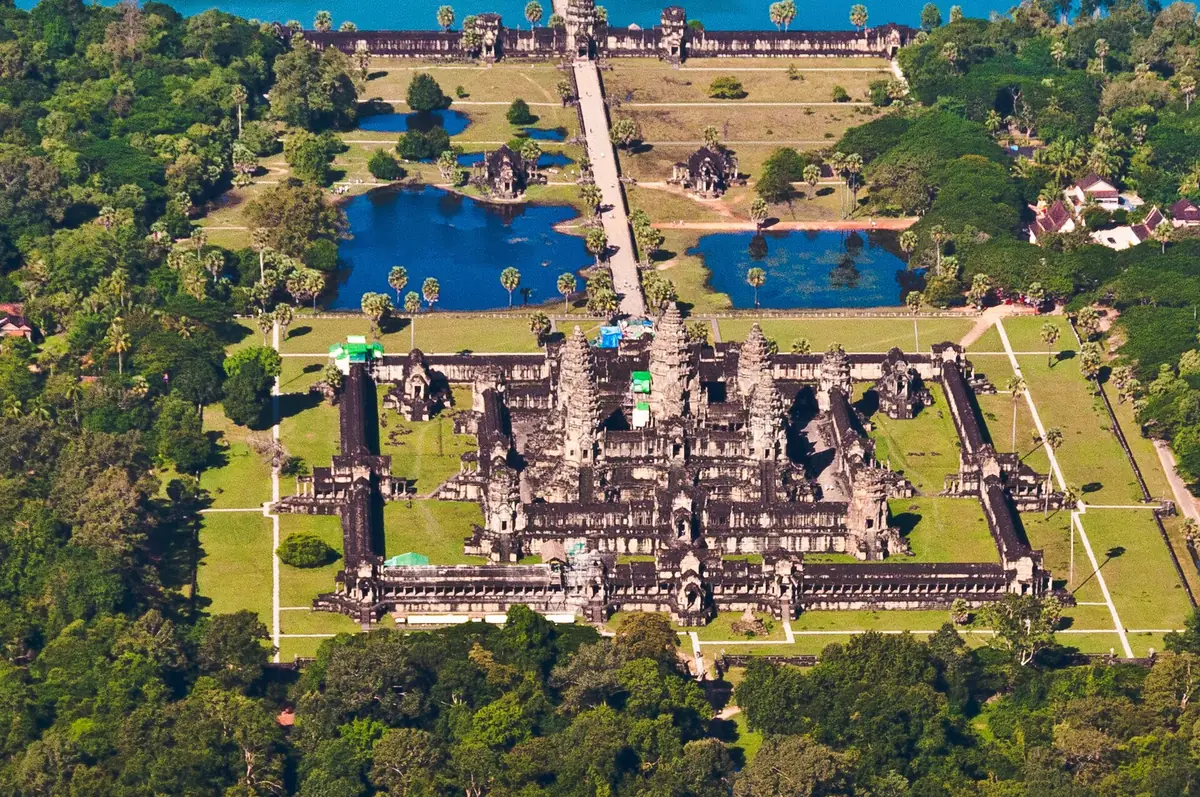
Aerial view of Angkor Wat with its moat, causeway and the five towers inside the square enclosure. Photo: Mark Fischer, CC BY-SA 2.0, via Wikimedia Commons
Quick answer Angkor Wat in brief
Angkor Wat is a 12th-century Khmer temple built for King Suryavarman II, dedicated to the god Vishnu and later Buddhist, standing about 6 km north of Siem Reap behind a moat 190 m wide. Its central tower rises 65 m above the ground and the outer wall runs 1,024 m by 802 m. Visiting needs an Angkor Pass, from US$37 for one day. Most travelers see it on a guided day from Siem Reap.
Key takeaways
- Compare the sunrise and small-group Angkor Wat tours from $15 per person.
- See the full comparison table of tours, prices and the pass cost on the homepage.
- Know where the panels are before you go: the Angkor Wat map guide lays out the circuits.
- Tickets, prices and the online pass are covered in the Angkor Wat tickets guide.
What Angkor Wat Is
Angkor Wat is a state temple of the Khmer Empire, built in the first half of the 12th century and still in religious use today.
Where It Stands and How Big It Is
Angkor Wat stands about 6 km north of Siem Reap, roughly 20 minutes by car or motorbike according to Wikivoyage. The site covers 162.6 hectares, a figure given both by Wikipedia and the official Angkor Enterprise explore page. A moat 190 m wide and more than 5 km around surrounds the whole enclosure, crossed on the west by a causeway 350 m long.
The temple faces west, unlike most Khmer temples, which face east. Scholars link this to Vishnu's association with the west or to a funerary purpose. Seen from the western causeway, the sun rises over the central tower at both equinoxes. The five towers form a quincunx, and the central one rises 43 m above the central shrine and 65 m above the ground.
- Distance from Siem Reap: about 6 km
- Site area: 162.6 hectares
- Moat: 190 m wide, more than 5 km around
- Central tower: 65 m above the ground
Who Built It and When
Angkor Wat was built under King Suryavarman II, who ruled from 1113 to about 1150. Construction began around 1122 and finished in 1150. The temple was dedicated to the Hindu god Vishnu and is generally regarded as Suryavarman II's state temple and mausoleum. Suryavarman II was enthroned in 1113, formally crowned in 1119 and died in 1150.
The original name may have been Vrah Vishnuloka or Parama Vishnuloka, the sacred dwelling of Vishnu, but no contemporary inscription confirms it. The modern name is simpler: Angkor comes from nokor, meaning city or capital, and wat means temple, so the name reads as Temple City. From the late 12th century the temple turned Buddhist, and it has been predominantly Theravada Buddhist since the late 13th century. In that conversion the central shrine was walled in and fitted with standing Buddhas.
The Largest Religious Structure
Britannica calls Angkor Wat the world's largest religious structure and puts the complex at about 400 acres. The site measures 162.6 hectares, a figure given both by Wikipedia and by the official Angkor Enterprise explore page. Britannica counts more than a thousand buildings in the complex.
One measurement divides the guidebooks: Britannica describes a 617 ft (188 m) bridge across the moat, while Wikipedia gives a 350 m western causeway. See the plan section below for the full set of measurements.
Sources: Wikipedia, Angkor Wat, Wikivoyage, Angkor, Angkor Enterprise.
From Hindu Temple to Buddhist Shrine
Angkor Wat began as a Hindu temple dedicated to Vishnu and ended as a Buddhist shrine. The turn came after a military disaster in the late 12th century.
The 1177 Sack and Jayavarman VII
Suryavarman II dedicated Angkor Wat to Vishnu and probably used it as his state temple and mausoleum. In 1177 the Cham of modern Vietnam sacked Angkor. Jayavarman VII, who took the throne in 1181, drew a conclusion from the defeat: the Hindu gods had failed him.
He turned to Buddhism, built a new capital at Angkor Thom and moved the state temple to the Bayon at its center. Angkor Wat became a Buddhist shrine, and many Hindu carvings were replaced with Buddhist art. If the Bayon is on your list, the Bayon temple guide covers the successor temple in detail.
Theravada Monks and Continuous Worship
Angkor Wat has been predominantly Theravada Buddhist since the late 13th century. The central shrine was walled in and fitted with standing Buddhas. What makes the temple unusual is that worship never stopped.
When the Angkor capital faded in the early 15th century, Theravada monks kept Angkor Wat as a pilgrimage site. In 1632 the Japanese pilgrim Ukondayu Kazufusa celebrated Khmer New Year there. The temple was neglected at times, but never abandoned.
An image of Angkor Wat has appeared on the Cambodian national flag since the first version in 1863. A guided day such as the Angkor Wat Full-Day Tour with Sunset gives Angkor Wat 2.5 hours with a guide.
Source: Britannica, History.com, Wikipedia.
The Plan: Moat, Galleries and Towers
The temple is a pyramid of three galleries rising toward five towers, enclosed by a wall and a moat.
The Measurements
The table gives the main measurements as Wikipedia records them. Three rectangular galleries rise one above the other toward the central tower. Inside, the cruciform cloister called Preah Poan, also known as the Thousand Buddhas gallery, links the outer gallery to the second enclosure.
| Part | Size | What it is |
|---|---|---|
| Outer wall | 1,024 m by 802 m, 4.5 m high, 30 m open apron | The outer boundary of the enclosure |
| Moat | 190 m wide, more than 5 km around | The water ring around the wall, crossed by a 350 m western causeway |
| Outer gallery | 187 m by 215 m | The first gallery, carrying most of the bas-reliefs |
| Second enclosure | 100 m by 115 m | Reached through the Preah Poan cruciform cloister |
| Bakan inner gallery | 60 m square | The upper level with the five towers |
| Central tower | 65 m above the ground, 43 m above the four surrounding towers | The highest point of the temple |
Mount Meru in Stone
The plan is a map of the Hindu cosmos. The central quincunx of five towers represents the peaks of Mount Meru, the home of the gods. The outer wall stands for the mountain range around Meru and the moat for the cosmic ocean. The 5 to 10 million sandstone blocks used in the building were quarried at Mount Kulen, about 40 km to the north-east.
You cross from the outside world to the cosmic mountain on the 350 m western causeway over the moat, which carries you to the western entry gate. Because the temple faces west, the main entrance is on the side most temples keep at the back.
Sources: Wikipedia, Angkor Wat.
The Bas-Reliefs Panel by Panel
Almost 1,000 square metres of bas-reliefs run around the outer gallery walls, and each gallery has its subject.
The Four Galleries
The reliefs cover almost 1,000 square metres and run counter-clockwise, the reverse of the normal order, which scholars match to Brahminic funeral rituals. The table lists each gallery as Wikipedia describes it. The Churning of the Sea of Milk, the best known panel, is 49 m long.
| Gallery | Panel | What it shows |
|---|---|---|
| West | Battle of Lanka | The monkey army of the Ramayana fighting the demon king Ravana |
| West | Kurukshetra War | The great battle of the Mahabharata |
| South | Procession of Suryavarman II | The only historical scene, showing the king's court and army |
| South | Heavens and hells | The 32 hells and 37 heavens of Hinduism |
| East | Churning of the Sea of Milk | Gods and demons churning the ocean for the elixir of life, with 92 asuras and 88 devas on the standard count |
| North | Victory over Bana | Krishna's victory over the demon Bana |
The Devatas and Apsaras
The walls carry carved female figures on a scale found nowhere else. More than 1,796 devata figures have been documented at the temple, and Sappho Marchal's 1927 study catalogued their hairstyles, headdresses and jewellery. The Suryavarman II article credits the temple with over 1,860 carved apsaras. The German Apsara Conservation Project found about 20% of the reliefs in very poor condition.
Give the galleries time. Most guided days, such as the Private Angkor Temple Highlights Tour at $31 per person, walk the outer gallery with a guide who can read the panels. The pass is not in that price.
Sources: Wikipedia, Angkor Wat.
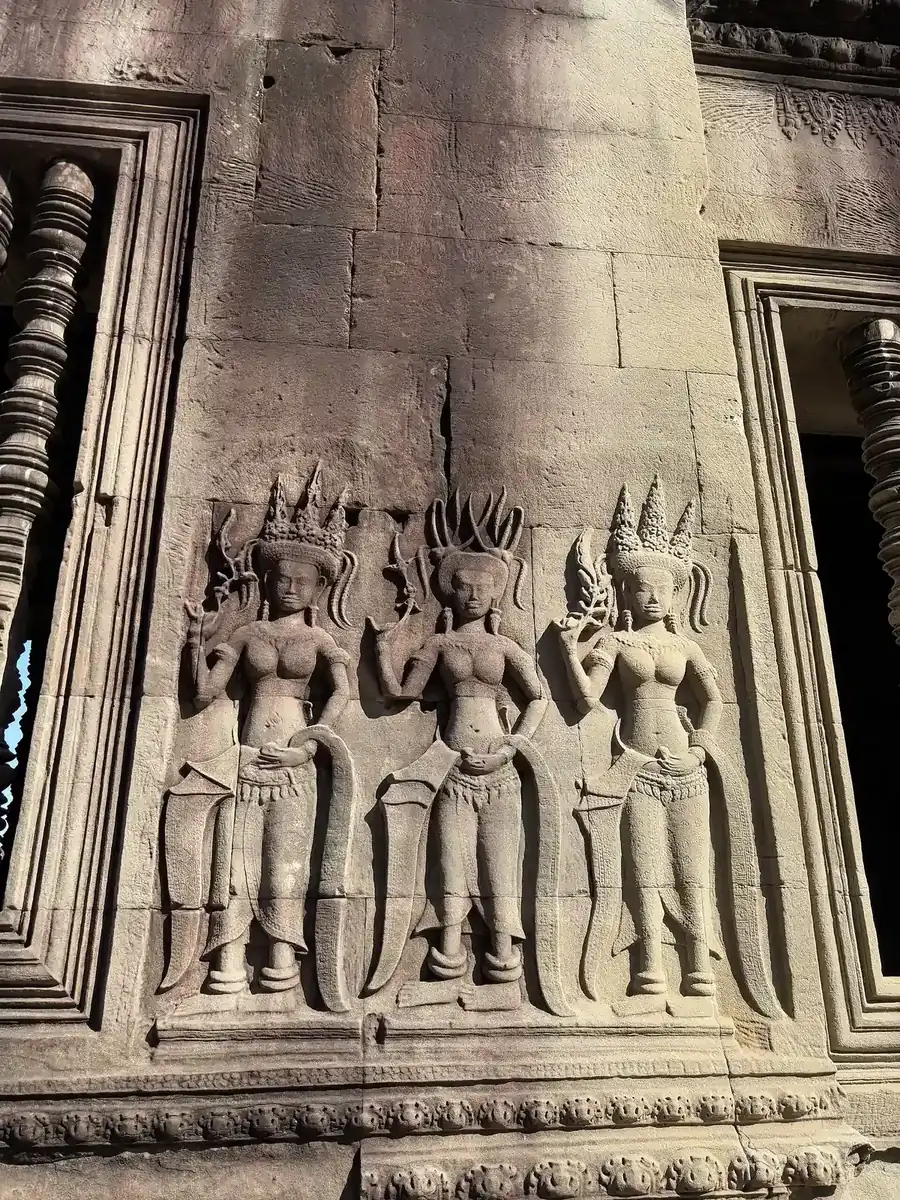
Apsara (celestial dancer) carvings on the sandstone wall of Angkor Wat. Photo: LayannAlkasaji, CC0, via Wikimedia Commons
The Upper Level and the Rules
The Bakan, the third tier under the five towers, is reached by one set of steps only.
Getting Up
The Bakan inner gallery is the 60 m square upper level under the central quincunx of towers. It is reached by steep stairways, three sets per side, which may represent the difficulty of reaching the realm of the gods. Today only the wooden steps with a handrail on the eastern side lead to the third tier, and Wikivoyage reports that the other stairways to it are closed.
The climb is steep even with the handrail, so take it slowly and hold the rail.
- Third tier access: the eastern wooden steps with a handrail only
- Other stairways to the upper level: closed
The Dress Rule Up There
The dress code matters most on the top tier. Since May 2019 the ban on bare shoulders has been strictly enforced on the uppermost level, and Wikivoyage is clear that a scarf over the shoulders is not accepted. Wear a shirt with sleeves and you will have no problem. Across the park generally, visitors are asked to wear long trousers or a skirt and covered shoulders, and too-short shorts or skirts can mean refused entry.
Check the signage on the day for any other rules on the upper level.
Sources: Wikivoyage, Angkor, Wikipedia, Angkor Wat.
Rediscovery, War and Restoration
The temple was never fully lost, but its story includes a French naturalist, a war and teams from eight countries.
From the 16th Century to Mouhot
Angkor Wat was largely neglected in the 16th century but never abandoned, and in 1632 the Japanese pilgrim Ukondayu Kazufusa celebrated Khmer New Year there. Its Western fame began with the French naturalist Henri Mouhot, who visited in 1860. His travel notes were published posthumously in 1864 and carried the temple into European imagination.
An image of Angkor Wat has appeared on the Cambodian national flag since the first version in 1863.
War, Looting and Repair
The French EFEO set up Conservation d'Angkor in 1908 and led restoration until 1970. Conservation d'Angkor was disbanded in 1975, Khmer Rouge forces burned remaining wood for firewood, and a shoot-out with Vietnamese forces left bullet holes still visible in the bas-reliefs. Thieves removed many sculptures in the late 1980s and early 1990s. The Archaeological Survey of India restored the temple from 1986 to 1992, work critics fault for its use of chemicals and cement.
Angkor was inscribed on the UNESCO World Heritage List in 1992, reference 668, and stayed on the Danger list until 2004. Restoration partners at Angkor today include France through the EFEO, Japan through JASA, India through the ASI, Germany through GACP, the United States through the World Monuments Fund, South Korea, China and Italy. Visitors followed the peace: Angkor Wat drew 7,650 visitors in 1993, over 1 million in 2007, over 2 million in 2012 and 2013, and 2.6 million in 2018. Figures dropped to about 280,000 in 2022 and passed 400,000 by late July 2023.
Sources: Wikipedia, Angkor Wat, Wikipedia, Angkor Archaeological Park.
Visiting Angkor Wat
A visit needs a pass, a plan for the light and a realistic idea of time.
The Pass and the Hours
Every visit needs the Angkor Pass, which is never in a tour price. The official Angkor Enterprise site sells the 1-day pass for US$37, the 3-day pass for US$62 and the 7-day pass for US$72. The 3-day pass expires in 7 days and the 7-day pass in 30 days, so your visit days must fall inside those windows.
The pass covers access to 50+ temples in the Angkor Temples Park. Official park entry runs from 5:00 AM to 6:30 PM on all three passes, and Wikivoyage reports that pass sales end at 17:30, with a pass bought after 17:00 counting from the next day. Children under 12 enter free with their passport.
Buying online in advance is covered step by step in the Angkor Wat tickets guide.
| Pass | Price | Validity |
|---|---|---|
| 1-day | US$37 | 1 day |
| 3-day | US$62 | 3 visit days inside 7 days |
| 7-day | US$72 | 7 visit days inside 30 days |
How Long and What Light
Wikivoyage suggests around 13:00-14:00 for the best light on a first visit, when the sun is high and the western facade is lit. Sunrise is also popular, and sunset is best seen from the top tier or from outside the main structure. Entry begins at 05:00 and temples open at sunrise, so a sunrise visit starts early and ends before the heat builds.
For a visit length, no official figure is published. The tour durations give a working range. A short private run covers Angkor Wat, Ta Prohm and Angkor Thom in 4 to 5 hours, while the Angkor Wat Small-Group Sunrise Tour runs 8 to 9 hours for $15 per person and the Angkor Wat Full-Day Tour with Sunset runs 9 hours for $14 per person and ends with sunset at Phnom Bakheng. The longest days at the temple come on multi-day routes: the Angkor Wat 2-Day Tour at $34 per person returns for a second day across the big circuit. None of these prices includes the pass, so budget the US$37 one-day ticket on top.
The Small Circuit and the Grand Circuit
The Small Circuit, called the Little Circuit by Wikivoyage, covers Angkor Wat, Angkor Thom and the temples to the east of it, including Ta Prohm. Wikivoyage notes that on the Little Circuit most stops are within about 15 minutes of each other by bike. The Grand Circuit adds the sites north and east, such as Preah Khan, Neak Pean, Ta Som and Pre Rup, about 30 minutes apart by bike.
The Angkor Wat 2-Day Tour splits the two circuits across two days, with the sunrise on day one and the big circuit ending at Phnom Bakheng on day two.
Sources: Angkor Enterprise, Wikivoyage, Angkor.
When to Visit Angkor Wat: Season by Season
Siem Reap never drops below 30 C as a monthly average high, so the question is heat and rain, not cold. Wikivoyage splits the year into three visiting windows.
The Three Windows
Wikivoyage calls November to February the peak season: dry, coolest at 25-30 C and busiest. March to May reaches up to 40 C, so go at the 05:00 park opening and finish by early afternoon. June to October is the rainy season and the temples are quietest, with the wettest months around September.
The figures below come from the Siem Reap climate record on Wikipedia.
| Season | Months | Typical conditions | Average high and rain, wettest month |
|---|---|---|---|
| Peak, dry and coolest | November to February | 25-30 C per Wikivoyage, biggest crowds | Nov high 31.2 C with 51.3 mm, Dec high 30.6 C with 7.3 mm |
| Hot season | March to May | Up to 40 C, visit at the 05:00 opening | Apr high 35.8 C with 57.3 mm, May high 34.8 C with 149.7 mm |
| Rainy and quietest | June to October | Fewest visitors, afternoon showers | Sep high 31.7 C with 287.7 mm, the wettest month |
Choosing Your Pass for the Season
Crowds follow the seasons, so a peak-season sunrise needs an early start and patience at the reflecting pool. Whatever the month, the Angkor Pass costs $37 (US$37) for 1 day, $62 (US$62) for 3 days and $72 (US$72) for 7 days on the official site. Hot-season visitors do best with a full-day itinerary that starts at opening, like the Angkor Wat Small-Group Sunrise Tour.
For a slower pace, the Angkor Wat 3-Day Tour spreads the Small Circuit, the Grand Circuit with Banteay Srei, and Beng Mealea over three days. More season detail sits in the Angkor Wat tours overview on Angkor Wat Tours.
Source: Wikivoyage, Wikipedia, Angkor Enterprise.
Do and Don't at Angkor Wat
Five things worth doing and four to avoid, each with the reason.
Do
- Do wear a shirt with sleeves and long trousers or a skirt, because covered shoulders and knees are the stated code and bare shoulders are refused on the uppermost level, where even a scarf is not accepted.
- Do buy your pass online before you go, because the 1-day pass costs US$37 and Angkor Enterprise sells passes on its own site and app.
- Do come around 13:00-14:00 for your first look at the temple, because Wikivoyage calls this the best light on the western facade.
- Do climb the eastern wooden steps with a handrail if you want the top tier, because it is the only access to the third tier and the other stairways are closed.
- Do bring your children's passports, because children under 12 enter Angkor free with a passport.
Don't
- Don't assume your tour price covers the temples, because no tour in the catalog includes the Angkor Pass and every listing adds it separately.
- Don't plan a sunset visit inside the temple, because the park closes at 6:30 PM and Wikivoyage says sunset is best from the top tier or outside the main structure anyway.
- Don't walk the galleries in the wrong direction by accident, because the reliefs are meant to be read counter-clockwise, matching Brahminic funeral rituals.
- Don't arrive after 17:30 expecting to buy a pass at the counter, because Wikivoyage reports pass sales end at 17:30 and the park closes at 18:30.
Angkor Wat Questions
What is Angkor Wat and why is it famous?
Angkor Wat is a 12th-century Khmer state temple built under Suryavarman II and dedicated to Vishnu, with almost 1,000 square metres of bas-reliefs and a 65 m central tower. Its image has been on the Cambodian flag since 1863. The Angkor Wat tours site covers how to visit it from Siem Reap.
Who built Angkor Wat?
The temple was built under King Suryavarman II, who ruled from 1113 to about 1150, and it served as his state temple and mausoleum. Wikipedia dates the construction work itself to 1122 to 1150. A guided day such as the Angkor Wat Small-Group Sunrise Tour at $15 per person puts a guide's telling of this history around you, with the $37 pass paid separately.
What does the name Angkor Wat mean?
Angkor comes from nokor, meaning city or capital, and wat means temple, so the modern name reads as Temple City. The original name may have been Vrah Vishnuloka, the sacred dwelling of Vishnu, but no inscription confirms it. More background on the temple and the region sits in the Siem Reap guide.
Can you climb to the top of Angkor Wat?
Yes, but only by the steep wooden steps with a handrail on the eastern side. The other stairways to the third tier are closed, and the ban on bare shoulders is strictly enforced on the uppermost level, with scarves not accepted. The Angkor Wat map guide shows where the eastern steps sit in the plan.
How long does a visit to Angkor Wat take?
No official duration is published. Tour durations give a range: short private runs cover the temple in 4 to 5 hours, standard guided days run 8 to 9 hours, and the Angkor Wat 2-Day Tour at $34 per person returns on a second day. The pass is not included in any of them.
Is Angkor Wat one of the seven wonders of the world?
Not as an official designation. Angkor is inscribed on the UNESCO World Heritage List, reference 668, since 1992, and was listed as in Danger until 2004. Claims that it is an eighth wonder are blog superlatives, not official designations. What you need for a visit is the pass, covered in the Angkor Wat tickets guide.
Which is older, Angkor Wat or the Pyramids?
The Pyramids are far older. Angkor Wat was built under Suryavarman II, with construction dated 1122 to 1150, while the Pyramids of Giza belong to ancient Egypt, thousands of years earlier. What Angkor Wat claims instead is scale: Britannica calls it the world's largest religious structure.
Why did Angkor Wat change from Hindu to Buddhist?
After the Cham sacked Angkor in 1177, King Jayavarman VII concluded that the Hindu gods had failed him and dedicated his reign to Buddhism, building Angkor Thom and moving the state temple to the Bayon. Angkor Wat became a Buddhist shrine and has been predominantly Theravada since the late 13th century. The Bayon temple guide covers the temple that replaced it.