 Angkor Wat Tours
Ta Prohm: the Tomb Raider Temple
Ta Prohm is the temple where huge trees grow straight out of the ruins, and the site Lara Croft: Tomb Raider made famous. King Jayavarman VII founded it in 1186 as a Buddhist monastery for his mother, and a stele records more than 12,500 people living and working here. This guide covers its history, the silk-cotton and thitpok trees, the India and APSARA conservation partnership, the crowds and the quieter side galleries, and which Angkor Wat tours actually stop here. No tour in the comparison includes the Angkor Pass, so every tour price on this page needs the US$37 one-day pass added on top. If you want the wider park first, start with Angkor Wat and the pass rules on the tickets page.
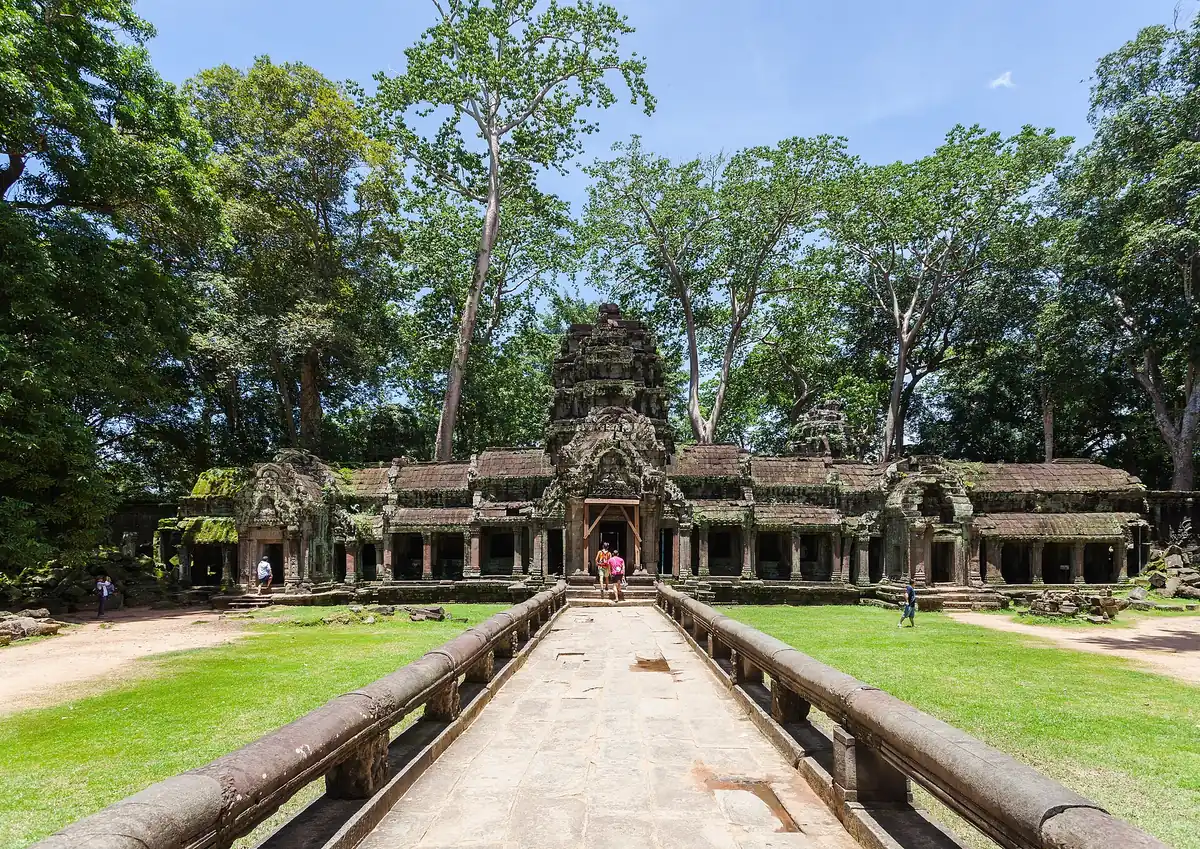
The paved approach and entrance gallery of Ta Prohm among tall trees. Photo: Diego Delso, CC BY-SA 3.0, via Wikimedia Commons
Quick answer Ta Prohm at a glance
Ta Prohm is a 12th-century Buddhist monastery at Angkor, founded by Jayavarman VII in 1186 and famous for trees growing over its ruins. The Angkor Pass to enter costs US$37 for one day, sold by Angkor Enterprise. No guided tour includes that pass in its price.
Key takeaways
- The cheapest guided day that stops here is the Angkor Wat Full-Day Tour with Sunset at $14 per person, plus the US$37 pass, so you pay $51.
- Want Ta Prohm as the headline stop? The Private Angkor Wat Ta Prohm Angkor Thom Tour covers Angkor Wat, Ta Prohm and Angkor Thom in 4 to 5 hours for $75 per person plus the pass.
- See how every tour price compares with the pass on the homepage price and cost section.
- Ta Prohm sits on the Small Circuit near Angkor Thom and Banteay Kdei.
What Ta Prohm Was
Ta Prohm began as a royal Buddhist monastery and school, built at the height of the Angkor kingdom.
Jayavarman VII and His Mother
Jayavarman VII founded Ta Prohm as a Mahayana Buddhist monastery and centre of learning, completed in 1186, during a reign that ran from 1181 to 1218. The same king built Preah Khan, the Bayon and Neak Pean, along with 102 hospitals and 121 rest houses across his empire. The temple was originally called Rajavihara, the Royal Monastery. The name Ta Prohm means ancestor Brahma.
The temple honours the king's mother. Its main image, the Prajnaparamita, the perfection of wisdom, was modelled on her. Ta Prohm lies inside the Angkor area inscribed by UNESCO in 1992.
The Size and the People
Ta Prohm is big. Its outer wall measures 1,000 by 650 m and encloses about 650,000 sq m. Wooden walkways run through the site while large unstable sections stay cordoned off.
The foundation stele records more than 12,500 residents inside the complex, including 18 high priests and 615 dancers, plus about 80,000 people in the surrounding villages who supported it. The Wikipedia article on Angkor gives a different figure, 12,640 people serving the complex. Either way, this was a working city of religion, dance and study, not a quiet shrine.
What the Film Did to the Name
Ta Prohm is now nicknamed the Tomb Raider temple because Lara Croft: Tomb Raider (2001) was filmed here. The film made the tree-covered ruins known to people who had never heard of Jayavarman VII. Ta Prohm is on the itinerary of nearly every tour compared here, from the $15 small-group sunrise day to the $75 private SUV morning, alongside Angkor Wat itself.
Sources: Wikipedia, Ta Prohm, Wikipedia, Jayavarman VII.
Layout and Where to Look
Ta Prohm is a flat temple you walk in one straight line, and the famous trees sit at known points along it. Knowing the layout saves you from doubling back in the heat.
Five Walls, One Line
The temple has five rectangular enclosure walls around a central sanctuary and faces east. Today you can enter only from the east or the west, so most people walk one way through the courtyards and exit the other side. The outer wall measures 1,000 by 650 m and encloses about 650,000 sq m. The galleries are single level, though large unstable sections are cordoned off and wooden walkways carry you through the site.
The stone is sandstone and laterite, built without mortar. Face towers were added to the gopuras in the 13th century and some have collapsed.
Where the Famous Trees Stand
Agate Travel puts the Crocodile Tree in the easternmost gopura, so look up as you enter from the east. Agate Travel names the Tomb Raider tree as the most photographed one. Agate Travel also notes that climbing on damaged galleries is restricted, so shoot from the path.
The temple carvings reward a slower pace too. Lucas Varro points to a Great Departure pediment that survived the iconoclasm under Jayavarman VIII, and a well-preserved face tower on the outer west gopura, alongside devatas and medallions. Agate Travel is a secondary source for the tree names, so treat the labels as guide tradition rather than official signage.
Combine It With Banteay Kdei
From the east gopura a 600 m path leads to Banteay Kdei, a mid-12th to early 13th century temple on the same side of the Small Circuit. Walking it after Ta Prohm adds a second temple to the morning without a long drive. Most guided days cover the pair anyway.
The Angkor Wat Small-Group Sunrise Tour visits Ta Prohm and Banteay Kdei after the sunrise, and the Angkor Wat Private Tuk-Tuk Tour includes both on its private route. If you want Ta Prohm as the headline stop, the Private Angkor Wat Ta Prohm Angkor Thom Tour runs 4 to 5 hours across just those three sites.
Source: Wikipedia, Agate Travel, Lucas Varro, Wikivoyage.
The Trees and the Ruins
The trees are the reason most people come, and they are also the reason Ta Prohm looks different from every other temple at Angkor.
Which Trees They Are
Sources disagree on the species, and it is worth knowing both names before a guide tells you only one. The giant trees crushing the galleries are either silk-cotton (Ceiba pentandra) or thitpok (Tetrameles nudiflora). The smaller trees are either strangler figs or gold apple. The practical effect is the same: roots pour down walls like melted wax, and trunks sit on top of the galleries.
This is the look the Tomb Raider film used, and it is what separates Ta Prohm from tidier monuments such as the Bayon temple.
Trees and Cordoned-Off Sections
The trees are part of the visit, and they sit among ruins that are not all safe to enter. Large unstable sections are cordoned off and you follow wooden walkways through the site rather than walking freely.
The Restoration by India and APSARA
Conservation at Ta Prohm is run as a partnership between the Archaeological Survey of India and the APSARA National Authority, the Cambodian body that manages Angkor. One result is the Hall of Dancers, where the renovation work was completed in November 2022.
The Crocodile Tree and the Tomb Raider Tree
Two names matter for photos. The Crocodile Tree stands in the easternmost gopura, so it is one of the first things you see entering from the east. Agate Travel calls the Tomb Raider tree the most photographed one.
Both names come from Agate Travel rather than official signage, and the species labels on the big trees are disputed anyway. The large trees are either silk-cotton or thitpok, and the smaller ones either strangler fig or gold apple. Climbing on damaged galleries is restricted, so keep to the wooden walkways and the marked path.
Sources: Wikipedia, Ta Prohm, Wikivoyage, Angkor.
Visiting Ta Prohm
Ta Prohm is one of the busiest stops in Angkor, but the crowds sit in a narrow band of the site and there are ways around them.
Crowds and the Side Galleries
The park is open from 5:00 AM to 6:30 PM on all Angkor passes, per the official Angkor Enterprise site. Wikivoyage notes that most visitors stick to a central route through Ta Prohm, so the sides of the complex can be surprisingly quiet. Heading out to the side galleries is the way around the crowds.
Banteay Kdei is reached from Ta Prohm's east gopura by a 600 m path, so you can walk on from the east side straight to Banteay Kdei.
Tours That Stop Here
Nearly every tour in the comparison lists Ta Prohm on its itinerary, from group sunrise days to private SUV mornings and bike tours. The one honest caveat repeats for all of them: the Angkor Pass is in no tour price. The one-day pass costs US$37 on the official Angkor Enterprise site, and the table shows what each tour costs with it where a total is given.
No tour in the comparison publishes how long it spends inside Ta Prohm, so that column says so rather than guessing.
| Tour | Price | Time at Ta Prohm |
|---|---|---|
| Angkor Wat Small-Group Sunrise Tour | $15, you pay $52 with the pass | not stated |
| Angkor Wat Highlights Sunrise Tour | $19, you pay $56 with the pass | not stated |
| Angkor Wat Full-Day Tour with Sunset | $14, you pay $51 with the pass | not stated |
| Angkor Sunrise Tour by Vespa or Tuk Tuk | $39, you pay $76 with the pass | not stated |
| Private Angkor Sunrise Tour | $30, plus the $37 one-day pass | not stated |
| Angkor Wat Private Tuk-Tuk Tour | $20 per group up to 3, pass extra | not stated |
| Private Angkor Temple Highlights Tour | $31, you pay $68 with the pass | not stated |
| Private Angkor Wat Ta Prohm Angkor Thom Tour | $75, you pay $112 with the pass | not stated |
| Angkor Wat Sunrise Private Tour | $52, you pay $89 with the pass | not stated |
| Angkor Wat 2-Day Tour | $34, you pay $96 with the pass | not stated |
| Angkor Wat and Floating Village 2-Day Tour | $235 per group up to 10, fees extra | not stated |
| Angkor Wat 3-Day Tour | $241.75, you pay $303.75 with the pass | not stated |
| Angkor Temples Bike Tour | $33, you pay $70 with the pass | not stated |
| Angkor Sunrise Cycling Tour | $69, you pay $106 with the pass | not stated |
The Pass You Need
Ta Prohm sits inside the Angkor Temples Park, so the same pass covers it as covers every other temple. Angkor Enterprise sells the 1-day pass for US$37, the 3-day pass for US$62 and the 7-day pass for US$72. The official site lists the 3-day pass as expiring in 7 days and the 7-day pass in 30 days.
You can buy online at the official ticket site, and children under 12 enter free with their passport. Full buying details, including the evening pre-entry trick, are on the Angkor Wat tickets page, and the map page shows where Ta Prohm sits on the Small Circuit.
Sources: Angkor Enterprise, Wikivoyage, Angkor, Wikipedia, Banteay Kdei.
Getting There and How Long to Stay
Ta Prohm sits on the Small Circuit east of Angkor Thom, an easy stop on any temple day. The figures below come from travel guides rather than an official source, so read them as ballparks.
Distance and Travel Time
Ta Prohm lies about 1 km east of Angkor Thom, on the southern edge of the East Baray. Agate Travel gives about 13 km and roughly 30 minutes by tuk-tuk from Siem Reap, and Exotic Voyages says over 12 km. No official source publishes a distance, so allow half an hour from town and you will not be far out. A tuk-tuk for the main temples costs about US$15 a day by Wikivoyage, or about US$25 per day for 3-4 people by Nomadic Matt, so a driver is the simple way in.
A private option that keeps the driving short is the Private Angkor Wat Ta Prohm Angkor Thom Tour, an SUV day with pickup around 4:45 AM.
How Long to Allow and When to Come
Agate Travel says to allow at least two hours at Ta Prohm. That fits the one-way walk from the east gopura to the west exit with time for the inner courts and the famous trees. The park opens from 5:00 AM and closes at 6:30 PM on all Angkor passes, and early morning stays coolest. Most visitors stick to a central route, so the sides of the complex can be surprisingly quiet (Wikivoyage).
On a guided day the temple is one stop among several. The Angkor Wat Highlights Sunrise Tour reaches Ta Prohm after the sunrise, and the Angkor Wat Full-Day Tour with Sunset puts it after lunch on a 9-hour day that starts with a pickup around 9:10 AM.
The Pass You Need, Corrected
Ta Prohm needs the standard Angkor Pass. The official Angkor Enterprise site sells the 1-day pass for US$37, the 3-day for US$62 and the 7-day for US$72. Agate Travel still prints a cost of about $20, which conflicts with the official US$37, so budget $37 for a single day.
The pass covers more than 50 temples across the park, so it also opens Angkor Wat, the Bayon and Angkor Thom on the same ticket. Children under 12 enter free with their passport (Wikivoyage). Every tour in the Angkor Wat tours comparison leaves the pass out of the listed price, so add the pass to the listed price before you compare.
Source: Angkor Enterprise, Wikipedia, Agate Travel, Exotic Voyages, Wikivoyage, Nomadic Matt.
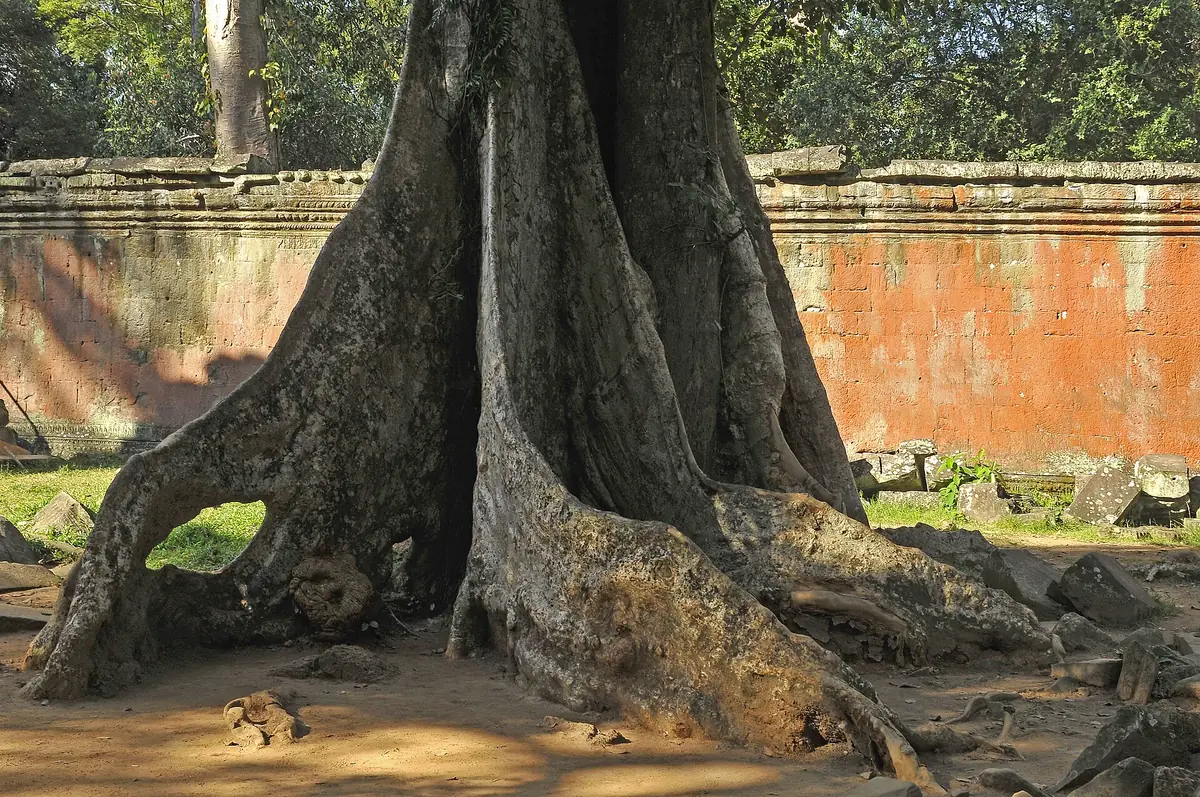
The buttressed base of a giant spung tree beside a laterite wall at Ta Prohm. Photo: LBM1948, CC BY-SA 4.0, via Wikimedia Commons
Tips for Ta Prohm
Do
- Do head for the side galleries, because most visitors stick to the central route and the sides can be surprisingly quiet.
- Do buy the Angkor Pass online before the day, because the one-day pass costs US$37 on the official site and no tour in the comparison includes it.
- Do wear long trousers or a long skirt with covered shoulders, because Angkor's dress code applies and a scarf over bare shoulders is not accepted.
- Do follow the wooden walkways, because large unstable sections of the ruins are cordoned off for your safety.
- Do pair Ta Prohm with Banteay Kdei, because a 600 m path from the east gopura connects the two.
Don't
- Don't assume your tour price includes entry, because the Angkor Pass is in no tour price and a $15 tour really means $52 once the pass is added as the listing states.
- Don't expect to wander everywhere, because the unstable galleries are closed and the restoration keeps them that way.
- Don't plan a visit before 5:00 AM or after 6:30 PM, because the official park entry runs 5:00 AM to 6:30 PM on all passes.
- Don't try to use someone else's pass, because your photo is printed on it and it is checked at almost all sites.
Ta Prohm FAQ
What temple was Tomb Raider filmed in?
Lara Croft: Tomb Raider (2001) was filmed at Ta Prohm, which is why the temple carries the Tomb Raider nickname. The Private Angkor Wat Ta Prohm Angkor Thom Tour visits Ta Prohm after the Angkor Wat sunrise.
Who built Ta Prohm and when?
Jayavarman VII founded Ta Prohm as a Mahayana Buddhist monastery, completed in 1186, and dedicated it to his mother with the Prajnaparamita image modelled on her. It is the same king behind the Bayon temple and Preah Khan.
Do I need a separate ticket for Ta Prohm?
No separate ticket exists. Ta Prohm is covered by the standard Angkor Pass, US$37 for one day on the official Angkor Enterprise site. The Angkor Wat tickets page explains the pass options and the evening pre-entry rule.
Is the Angkor Pass included in tour prices?
No, it never is. Every tour in the comparison charges the pass on top, for example the $15 small-group sunrise day means you pay $52 with the pass as the listing states. The homepage cost section sets out the totals.
Why does Ta Prohm still have trees growing over it?
The giant trees are either silk-cotton or thitpok, with sources disagreeing on the species. The Archaeological Survey of India and APSARA now conserve the site together. Nearby Preah Khan has a similar tree-covered look.
How much time should I plan at Ta Prohm?
Not stated by any official source, and no tour in the comparison publishes its time on site.
Where is the biggest Hindu temple in Cambodia?
That question points to Angkor Wat, not Ta Prohm. Ta Prohm was a Buddhist monastery built by Jayavarman VII, while Angkor Wat began as a Hindu temple under Suryavarman II. The full picture is in the Angkor Wat guide.
Where is the Crocodile Tree?
Agate Travel places the Crocodile Tree in the easternmost gopura of Ta Prohm, so look up as you enter from the east side. Agate Travel names the Tomb Raider tree as the other photo stop. The species of the big trees is disputed between silk-cotton and thitpok.
How long does Ta Prohm take?
Allow at least two hours, the figure Agate Travel gives. The walk runs one way from the east gopura to the west exit through five enclosure walls, and the pass gives you park entry from 5:00 AM to 6:30 PM. Guided days such as the Angkor Wat Highlights Sunrise Tour fit it in after the sunrise.
Why is Angkor Wat temple so famous?
Wikipedia calls Angkor Wat a symbol of Cambodia, and it appears on the national flag. It sits in the same park as Ta Prohm. One Angkor Pass at US$37 covers both. The Angkor Wat guide has the detail.