 Angkor Wat Tours
Phnom Bakheng: the First Temple Mountain and Its Sunset
Phnom Bakheng is the hilltop temple just north of Angkor Wat, and it is the most famous sunset spot in the Angkor Archaeological Park. Built at the end of the 9th century, it is older than Angkor Wat by more than two centuries. This guide covers the hill, its five sanctuaries, the 108 smaller towers, the climb, the 17:30 climbing cut-off, the elephant rides, and the tours that end their day here. The Angkor Pass is never included in a tour price, so the price on top is stated every time. For dawn instead of dusk, the Angkor Wat sunrise guide has that covered. You can also compare every Angkor Wat tour on the homepage.
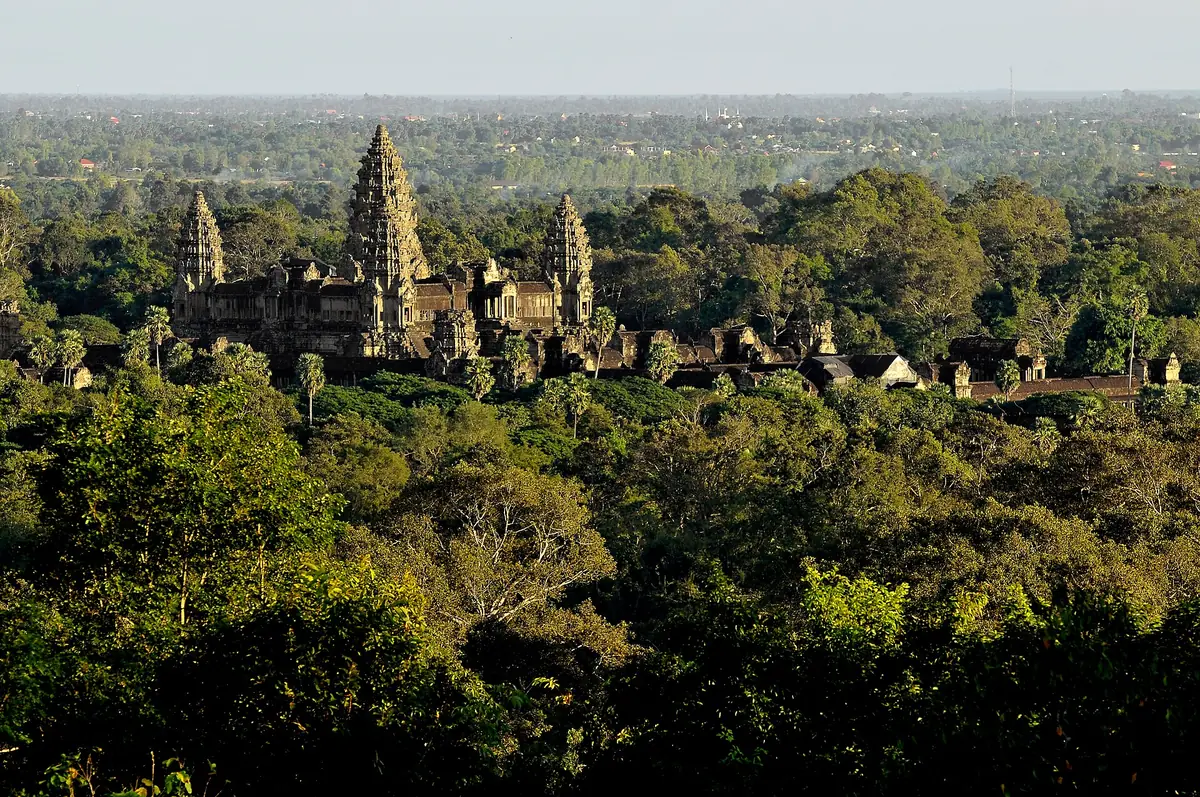
Angkor Wat seen across the forest canopy from the Phnom Bakheng hilltop. Photo: LBM1948, CC BY-SA 4.0, via Wikimedia Commons
Quick answer Phnom Bakheng at a glance
Phnom Bakheng is a late 9th century temple mountain on a hill 79 m above sea level, about 1.5 km north-west of Angkor Wat, and a very crowded sunset spot. The climb up takes about half an hour and you are not allowed to start climbing after 17:30. A shared full-day tour that ends here costs from $14, with the $37 one-day Angkor Pass always paid separately.
Key takeaways
- The Angkor Wat Full-Day Tour with Sunset is $14 per person plus the $37 Angkor Pass, a total the listing puts at $51, and it ends with sunset on Phnom Bakheng.
- Want two days and a slower pace? The Angkor Wat 2-Day Tour closes day two with a Phnom Bakheng sunset, and its $34 price also leaves the Angkor Pass out.
- Compare every option in the tour comparison table, including each tour's price with the pass added.
The First Temple Mountain
Phnom Bakheng was built at the end of the 9th century, long before Angkor Wat and the Bayon.
A Temple Older Than Angkor Wat
Yasovarman I, who reigned from 889 to 910, built Phnom Bakheng as the state temple of his capital, Yasodharapura. That makes it a creation of the end of the 9th century, more than two hundred years before Angkor Wat was begun in the 12th. The hill stands about 1.5 km to the north-west of Angkor Wat.
If you want the full story of the better known neighbour, the Angkor Wat guide covers it, and the Bayon temple guide covers the face towers inside Angkor Thom.
How High Is Phnom Bakheng?
Sources give two figures and both are worth knowing. Wikipedia's infobox puts the summit at 79 m above sea level, and the same article says the temple stands about 65 m above the surrounding plain. The Khmer Empire article on Wikipedia gives about 60 m above the plain, so expect a short but real hill climb rather than a mountain trek.
The temple itself is a tiered sandstone pyramid on the hilltop. Five sanctuaries in a quincunx pattern crown the top level, and about 108 smaller towers were originally arranged around the tiers, many of which have not survived.
Towers and Conservation
Five sanctuaries crown the top level and about 108 smaller towers were originally arranged around the tiers. The World Monuments Fund has worked with the APSARA National Authority at the site since 2004. The walk up from the road takes about half an hour, according to Wikivoyage, and no climbing is allowed after 17:30, so a sunset visit means setting off in good time.
The dress code of the other Angkor temples applies here too: shoulders covered and long trousers or a long skirt, with a scarf over bare shoulders not accepted.
Counting the Towers
Wikipedia says 108 small towers were originally arrayed around the temple and most have since collapsed. It also gives Jean Filliozat's count of 104 smaller towers on the lower four levels, placed so that only 33 can be seen from the centre of any side. Just Siem Reap repeats the 104 and 33 figures.
The site also did not stay in use for long: World Monuments Fund records that the temple was abandoned a few decades after it was finished.
Sources: Wikipedia, Phnom Bakheng, Wikivoyage, Angkor
Restoration: What Is Open and What Is Not
The World Monuments Fund has been repairing the hill temple with APSARA since 2004, and parts of it close from time to time while the work continues.
The Project So Far
The World Monuments Fund began work here in 2004 with a grant of $550,000, and a Conservation Master Plan followed in 2007. Conservation of the east half of the central temple was completed in 2019, and in 2023 the fund began work on the west half and a visitor centre. More than $5 million has gone into the hill so far, and more than 100 local workers are employed on the project.
Closures During the Works
Journey Cambodia reports that Tower 15 was fully restored in early 2025 and that some areas of the temple are sometimes off-limits while work proceeds. This is an operator's account rather than an APSARA notice, so check on arrival which paths and stairways are open.
Source: World Monuments Fund, Journey Cambodia.
What the Temple Means
The hill temple is more than a viewpoint. Its shape, tier count and tower layout encode a Hindu picture of the cosmos.
A Built Mount Meru
World Monuments Fund describes the seven-level stepped pyramid as a representation of Mount Meru, the mythical centre of the Hindu universe. The five sandstone sanctuaries on the top platform stand in a quincunx, one in each corner and one in the middle, and they stand for the five peaks of Meru. Guardian lions line the terraces.
An Astronomical Calendar in Stone
The 108 small towers around the tiers were linked to the four lunar phases by the scholar Jean Filliozat, and Paul Wheatley called the temple 'an astronomical calendar in stone'. Wikipedia gives 108 as the original number and says most have since collapsed. A later Buddhist layer sits on top of all this: World Monuments Fund records a 16th-century attempt to build a large seated Buddha around the central shrine, since dismantled, and Wikipedia notes a reclining Buddha carved on the west side.
Built Early, Abandoned Fast
Yasovarman I (r. 889-910) built Phnom Bakheng as the state temple of his capital Yasodharapura, well before Angkor Wat. World Monuments Fund notes the site was abandoned only a few decades after it was completed.
Source: World Monuments Fund, Wikipedia.
Sunset on Phnom Bakheng
Sunset is why most people come, and the rules and the timing matter here.
The 17:30 Rule
You are not allowed to climb Phnom Bakheng after 17:30, per Wikivoyage. That is earlier than the park-wide closing time of 6:30 PM that the official Angkor Enterprise ticket page gives for entry, so this hill closes its climb before the rest of the park shuts. The climb itself takes about half an hour, per Wikivoyage, so arrive with enough time to walk up, find a spot on the tiers, and settle in before the light goes.
Wear shoes with a grip for the climb.
What Time Is Sunset?
Sunset moves across the year in Siem Reap between roughly 5:34 pm and 6:35 pm. Sunrise-sunset.org gives 5:56 pm on 15 January, 6:14 pm on 15 March, 6:32 pm on 15 June, 6:35 pm on 15 July, and 5:39 pm on 15 December. The earliest sunset of the year falls at 5:34 pm on 19 November and the latest at 6:35 pm on 9 July.
In the months when the sun sets around 5:34 pm, the 17:30 climbing cut-off falls close to sunset, so start the climb well before it.
The View
The sun does not set over Angkor Wat when viewed from Phnom Bakheng, per Wikivoyage. Angkor Wat lies about 1.5 km to the south-east, so you look down on its silhouette and its towers against the evening sky, but the sun itself drops elsewhere on the horizon. It is still a wide, open view over the plain and the forest.
Sunset Alternatives
Wikivoyage calls Phnom Bakheng very crowded. It names Pre Rup as a popular sunset spot over the countryside. Pre Rup was dedicated in 961 or early 962 by Rajendravarman and its pyramid rises about 12 m on a base 50 m square, per Wikipedia.
The sunset option of the Angkor Wat Private Tuk-Tuk Tour covers Pre Rup, East Mebon, Ta Som, Neak Pean, Preah Khan and Phnom Bakheng. A private tuk-tuk for a full day of Angkor runs about $20 per Wikivoyage's Siem Reap page, a bit more for sunrise or sunset itineraries.
Elephant Rides: What They Cost and Why to Skip Them
An elephant ride down the hill costs US$15 per person, per Wikivoyage, which advises avoiding them for animal welfare reasons. Walking down is the alternative.
The Walk Up and the Dark Walk Down
Most people approach from the east gate on the Angkor Thom side, and Where's Ben Been puts the walk from that gate to the base at about 20 minutes. Journey Cambodia describes a 15 to 20 minute uphill walk on an unpaved road, with steep and uneven stairs near the top, and advises bringing a flashlight for the way down because it is dark after sunset. Wikivoyage allows half an hour for the climb.
Just Siem Reap adds that many tuk-tuks queue at the bottom in the evening, so it can pay to let the crowds thin before descending. As for sunrise, Where's Ben Been claims the sun rises over the Angkor Wat towers from here at the equinox, but that claim appears only on that blog, so treat it as a possibility rather than a promise.
Sources: Wikivoyage, Angkor, sunrise-sunset.org, Siem Reap, Wikipedia, Pre Rup, Angkor Enterprise
Is Phnom Bakheng in Tomb Raider, and Other Sunset Spots
The hill had a film moment, and when the platform queue is too long there are several other places in the park to watch the light go.
The Tomb Raider View
Wikipedia notes that the view of Angkor Wat from the top of Phnom Bakheng appears in the film Tomb Raider, in the scene where Lara Croft looks through binoculars on arriving in Cambodia. Angkor Wat lies about 1.5 km to the south-east of the hill. Just Siem Reap suggests 1 to 2 hours at the temple.
Where Else to Watch the Sunset
Journey Cambodia names Pre Rup, Srah Srang, Phnom Bok and the Angkor Wat moat as backups when Phnom Bakheng is too crowded. Wikivoyage separately lists Pre Rup, a pyramid about 12 m high dedicated in 961 or early 962, as a popular sunset spot over the countryside. The comparison of Angkor Wat tours from Siem Reap shows which full-day itineraries finish on the hill and which finish elsewhere.
Tours That End on the Hill
If you would rather not manage the crowd timing alone, several catalog tours finish the day at Phnom Bakheng, the tuk-tuk tour only on its big-tour sunset option. The figures below are the listing prices plus the Angkor Pass each tour says you pay on top, taken from the tour cards.
| Tour | Price | Pass you pay | Duration |
|---|---|---|---|
| Angkor Wat Full-Day Tour with Sunset | $14 | $37 (one-day pass, total $51 as listed) | 9 hours |
| Angkor Wat Private Tuk-Tuk Tour | $20 per group up to 3 | Not stated on the listing | 8 to 9 hours |
| Angkor Wat 2-Day Tour | $34 | Not stated on the listing (card total $96) | 2 days |
| Angkor Wat 3-Day Tour | $241.75 | $62 (total $303.75 as listed) | 3 days |
Source: Wikipedia, Journey Cambodia, Just Siem Reap, Wikivoyage.
The Sunset Crowd Limit and When to Arrive
The top platform is managed at sunset, and turning up late can mean missing the view. Here is what the rules are and when to be at the base.
The Cap on the Top Platform
World Monuments Fund says that since 2011 a joint policy with the APSARA National Authority has limited the number of visitors allowed on the top platform during sunset. The exact number is not published on an official page. Where's Ben Been puts it at 300 people at a time, and Journey Cambodia also quotes 300, though it says both '300 at once' and '300 per day' in different places, so treat the figure as unconfirmed.
Expect a queue on the stairs and a wait for your turn at the top.
Arrival Times by Season
Journey Cambodia advises arriving by 3:30 PM in November to January, 4:00 PM in February to April and 4:30 PM in May to October. It also lists Phnom Bakheng's hours as 5:00 AM to 7:00 PM, which sits oddly beside the official park window of 5:00 AM to 6:30 PM on angkorenterprise.gov.kh, so plan around the official closing time. Climbing stops at 17:30 per Wikivoyage, so on any day when the sun sets after that you will want to be up top before the cut-off rather than at the base.
Getting Down After Dark
The walk down happens in the dark, so bring a flashlight. Just Siem Reap notes that many tuk-tuks queue at the bottom and it pays to wait for the crowds to thin before you head down. An elephant ride down costs US$15 per person per Wikivoyage, which advises against it for animal welfare reasons.
Source: World Monuments Fund, Where's Ben Been, Journey Cambodia, Just Siem Reap.
Tours That End Here
Several tours in the catalog name Phnom Bakheng in their itinerary. None of them includes the Angkor Pass in its price, and the pass is the line you must add yourself. A one-day pass costs US$37 and a three-day pass US$62, per the tour listings and the official site angkorenterprise.gov.kh, and children under 12 do not need a temple ticket on the tours that state it. The table compares the four, using each tour's own from price and its own stated total with the pass where the listing gives one. Free cancellation of 24 hours applies to all four.
Comparing the Itineraries
The Angkor Wat Full-Day Tour with Sunset is the simplest fit for this page: a 9-hour small-group day of at most 13 people that runs Angkor Wat, Angkor Thom, the Bayon and Ta Prohm, then finishes with sunset at Phnom Bakheng. Pickup is 9:10 AM to 9:30 AM. The listing puts your total at $51, the $14 price plus the $37 pass.
The Angkor Wat 2-Day Tour spreads the temples over two days and closes day two with the same sunset, at $34 per person plus the pass, a stated total of $96. For a longer stay, the Angkor Wat 3-Day Tour is a private three-day itinerary that includes Phnom Bakheng on day one, priced at $241.75 per person with the $62 three-day pass added at checkout, giving $303.75.
| Tour | Price | Finish |
|---|---|---|
| Angkor Wat Full-Day Tour with Sunset | $14 per person plus the $37 pass, $51 in total per the listing | Phnom Bakheng sunset, 9 hours, group up to 13 |
| Angkor Wat 2-Day Tour | $34 per person plus the pass bought yourself, $96 total stated | Day 2 ends with a Phnom Bakheng sunset |
| Angkor Wat 3-Day Tour | $241.75 per person plus the $62 three-day pass, $303.75 stated | Day 1 ends at Phnom Bakheng |
| Angkor Wat Private Tuk-Tuk Tour | $20 per group up to 3, pass bought separately, no total stated | Sunset option covers Phnom Bakheng and Pre Rup |
What the Prices Leave Out
Read the pass line before you book any of these. The full-day tour and the two-day tour tell you to buy your pass on angkorenterprise.gov.kh or at the ticket office, the three-day tour has the guide take you to buy it on day one, and the private tuk-tuk tour states no amount at all. Lunch is extra on the full-day and two-day tours, paid at a local restaurant, and lunches on the three-day tour cost from about US$5 per dish.
If you would rather build your own day, the homepage sections on what a tour costs and the Angkor Pass and going on your own break the numbers down.
Sources: Angkor Enterprise for the pass.
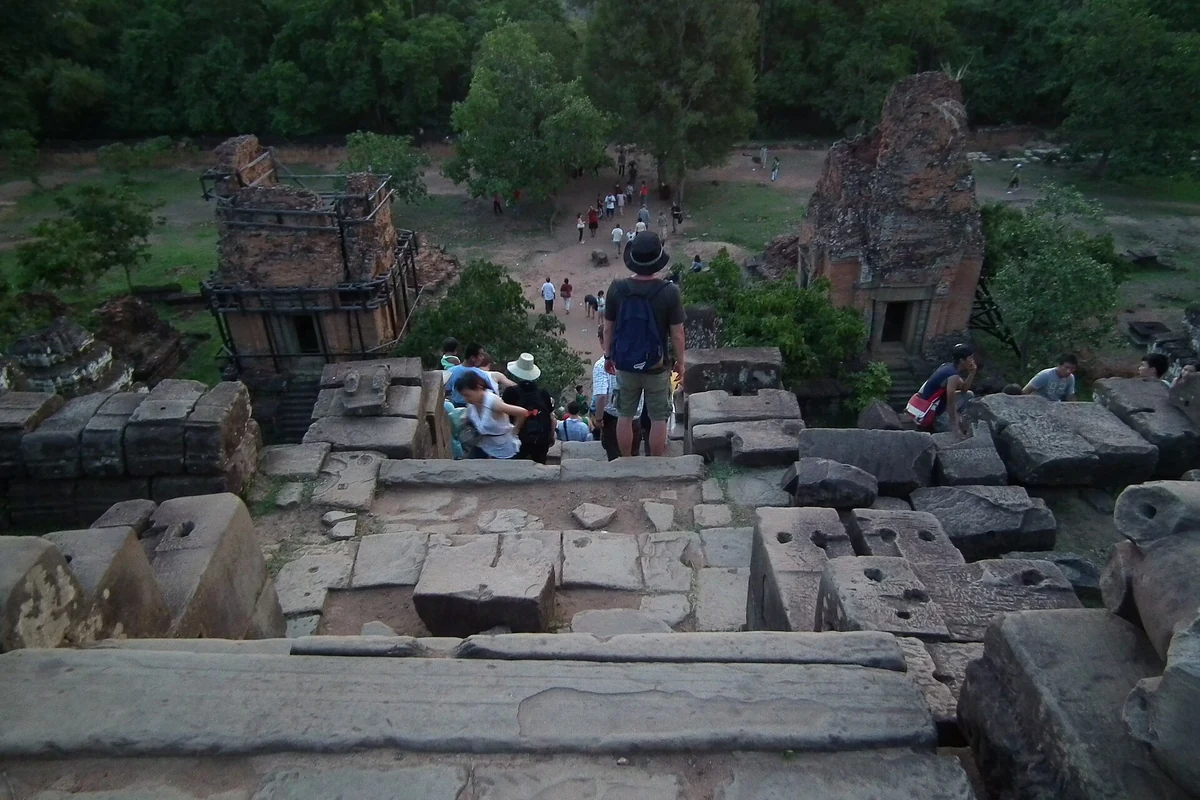
Visitors on the stone terraces of the Phnom Bakheng summit looking out over the forest. Photo: 松岡明芳, CC BY-SA 3.0, via Wikimedia Commons
Phnom Bakheng Questions
What is Phnom Bakheng?
It is a late 9th century Hindu temple mountain built by Yasovarman I (889-910) as the state temple of his capital Yasodharapura, on a hill whose summit is 79 m above sea level. Five sandstone sanctuaries crown the top and about 108 smaller towers were originally planned around the tiers. The Angkor Wat guide covers the later temples nearby.
How long does the Phnom Bakheng climb take?
Allow about half an hour for the climb to the top, per Wikivoyage. Start early enough to clear the 17:30 climbing cut-off. The Angkor Wat Full-Day Tour with Sunset ends its 9-hour day on the hill.
Can you see the sunset over Angkor Wat from Phnom Bakheng?
No. Wikivoyage states plainly that the sun does not set over Angkor Wat when viewed from Phnom Bakheng. Angkor Wat lies about 1.5 km to the south-east and you see its silhouette against the evening sky, but the sun drops elsewhere. Pre Rup is the alternative countryside sunset named by Wikivoyage.
What time does Phnom Bakheng close?
The rule that matters is the climbing cut-off: you cannot climb after 17:30, per Wikivoyage, while the park-wide entry window runs 5:00 AM to 6:30 PM per the official Angkor Enterprise ticket page. Sunset in Siem Reap falls between 5:34 pm and 6:35 pm across the year, so in November and December the cut-off falls close to sunset. The Angkor Wat 2-Day Tour closes day two on the hill.
Should I take the elephant ride down Phnom Bakheng?
Wikivoyage lists the ride down at US$15 per person and advises avoiding it for animal welfare reasons. None of the Angkor Wat tours in the catalog includes the ride.
Do I need the Angkor Pass for Phnom Bakheng, and do tours include it?
Yes, the hill is inside the Angkor Archaeological Park, so the pass applies: US$37 for one day or US$62 for three days. No tour in the catalog includes it in the tour price. The Angkor Wat 3-Day Tour adds the $62 pass at checkout, and the full-day sunset tour's listing puts your total at $51 including the $37 pass.
Is there a limit on how many people can go up Phnom Bakheng at sunset?
Yes. World Monuments Fund says a 2011 policy with the APSARA National Authority limits the number of visitors on the top platform at sunset, so expect a queue. Blogs quote a cap of 300 people at a time, but no official page confirms the number. See the sunset guide.
What does Phnom Bakheng symbolise?
The seven-level pyramid represents Mount Meru, the centre of the Hindu universe, and the five top shrines stand for its five peaks, per World Monuments Fund. Wikipedia records that the 108 towers were linked to the four lunar phases, an astronomical calendar in stone. Details are in the guide to Phnom Bakheng.
Was Tomb Raider filmed at Phnom Bakheng?
Partly. Wikipedia notes that the view of Angkor Wat from the top of Phnom Bakheng appears in the film Tomb Raider, when Lara looks through binoculars on arriving in Cambodia. The fuller picture is in the Phnom Bakheng guide.
How much time do I need at Phnom Bakheng?
Just Siem Reap suggests 1 to 2 hours. Where's Ben Been puts the walk from the east gate to the base at about 20 minutes, and Wikivoyage allows half an hour for the climb. If you want a guided day that ends there, compare Angkor Wat tours that finish on the hill.